
Bachelor of Computer Application – AI & ML –in association with Microsoft CloudThat
Duration4 Years
Course Fee7.10 Lakhs
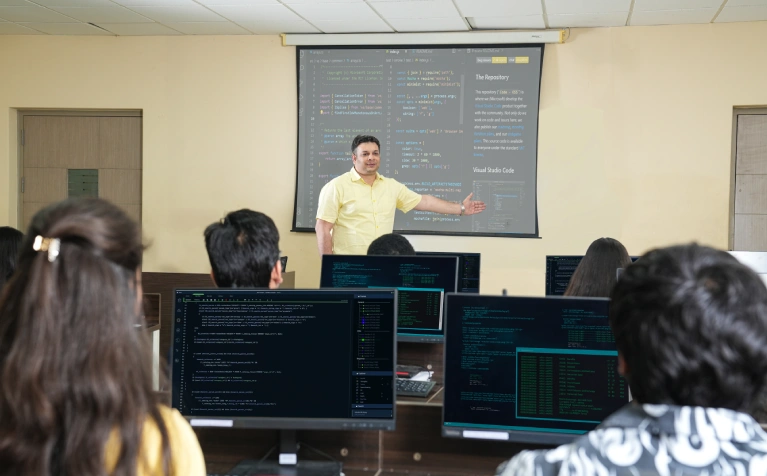
The BCA in Artificial Intelligence & Machine Learning is a future-oriented undergraduate program designed to build expertise in intelligent computing systems that can learn, adapt, and make decisions.
The program integrates core computer science fundamentals with advanced topics such as machine learning algorithms, deep learning, neural networks, natural language processing, and computer vision. Students gain a strong foundation in programming (Python, Java), data structures, and algorithms, along with specialized AI frameworks such as TensorFlow, Keras, and PyTorch. The curriculum emphasizes experiential learning through lab-based sessions, industry projects, and real-world problem-solving.The program also focuses on developing analytical thinking, mathematical modeling, and the ability to design AI-driven applications across domains like healthcare, finance, smart cities, and automation. Ethical AI, explainable AI, and responsible use of technology are also integrated into the curriculum to ensure socially responsible professionals. Graduates of this program will be capable of designing intelligent systems, building predictive models, and contributing to the growing AI ecosystem globally.
Program Specific Outcomes (PSO)
PSO 01
To learn the concepts of computer science and applications such as operating systems, computer networks, computer organization and architecture, DBMS, and data structures that meet the desired needs of industry and society.
PSO 02
To analyze their abilities in systematic planning, developing, testing, and executing complex computing applications in the field of social media and analytics, web application development and data interpretations, and machine learning and data analytics for providing solutions to computational problems.
PSO 03
Graduates would expertise in successful careers based on their understanding of formal and practical methods.
Programme Outcomes (PO)
Apply the knowledge of mathematics, science, engineering fundamentals, and an engineering specialization to the solution of complex engineering problems.

Identify, formulate, review research literature, and analyze complex engineering problems reaching substantiated conclusions using first principles of mathematics, natural sciences, and engineering sciences.
Design solutions for complex engineering problems and design system components or processes that meet the specified needs with appropriate consideration for the public health and safety, and the cultural, societal, and environmental considerations.
Use research-based knowledge and research methods including design of experiments, analysis and interpretation of data, and synthesis of the information to provide valid conclusions.
Create, select, and apply appropriate techniques, resources, and modern engineering and IT tools including prediction and modeling to complex engineering activities with an understanding of the limitations.
Apply reasoning informed by the contextual knowledge to assess societal, health, safety, legal and cultural issues and the consequent responsibilities relevant to the professional engineering practice.
Understand the impact of the professional engineering solutions in societal and environmental contexts, and demonstrate the knowledge of, and need for sustainable development.
Apply ethical principles and commit to professional ethics and responsibilities and norms of the engineering practice.
Function effectively as an individual, and as a member or leader in diverse teams, and in multidisciplinary settings.
Communicate effectively on complex engineering activities with the engineering community and with society at large, such as, being able to comprehend and write effective reports and design documentation, make effective presentations, and give and receive clear instructions.
Demonstrate knowledge and understanding of the engineering and management principles and apply these to one’s own work, as a member and leader in a team, to manage projects and in multidisciplinary environments.
Recognize the need for, and have the preparation and ability to engage in independent and life-long learning in the broadest context of technological change.
Curriculum Details
| Course Code | Course Title | L | T | P | Credits |
|---|---|---|---|---|---|
| MAT1705 | Basic Mathematics | 3 | 1 | 0 | 4 |
| CAP1005/CAP1005L | Problem solving and programming through C | 3 | 0 | 2 | 4 |
| CAP1004/CAP1004L | Introduction to IT | 3 | 0 | 2 | 4 |
| VAC001 | Design Thinking | 2 | 0 | 0 | 2 |
| COM1515 | Contemporary English Skills | 2 | 0 | 0 | 2 |
| CAI1012 | Machine Learning Industry vertical | 2 | 0 | 0 | 2 |
| FIN1799 | Basics of Financial Management | 3 | 0 | 0 | 3 |
| CAP1502L | PC Software Lab/Engineering Workshop | 0 | 0 | 2 | 1 |
| Total Credits | 22 | ||||
| Course Code | Course Title | L | T | P | Credits |
|---|---|---|---|---|---|
| CAP2702 | Computer System Architecture | 3 | 0 | 0 | 3 |
| CAI1009/CAI1009L | Mathematics for Machine Learning (2L and 2P) | 2 | 0 | 2 | 3 |
| CAP2007/ CAP2007L | Principles of Operating Systems | 3 | 0 | 2 | 4 |
| CAP2001/ CAP2001L | Data Structure using C | 3 | 0 | 2 | 4 |
| LAW3702 | Constitution Of India | 3 | 0 | 0 | 3 |
| COM1521 | Communication Skills and Ability Enhancement | 2 | 0 | 0 | 2 |
| VAC002 | Innovation ,Entrepreneurship and Sustainability | 1 | 0 | 2 | 2 |
| Total Credits | 21 | ||||
| Course Code | Course Title | L | T | P | Credits |
|---|---|---|---|---|---|
| CAP2017/CAP2017L | Introduction to Object Oriented Concepts Using Java | 3 | 0 | 2 | 4 |
| CAP2002/ CAP2002L | DBMS with NOSQL | 3 | 0 | 2 | 4 |
| IDP1 | 3 | 0 | 0 | 3 | |
| CAP3004/CAP3004L | Artificial Intelligence | 3 | 0 | 0 | 3 |
| CAP2018/CAP2018 | Design and Analysis of Algorithm | 2 | 0 | 2 | 3 |
| HUM2790 | Essense of Indian Traditional Knowledge | 3 | 0 | 0 | 3 |
| COM2521 | Academic Writing | 2 | 0 | 0 | 2 |
| Total Credits | 21 | ||||
| Course Code | Course Title | L | T | P | Credits |
|---|---|---|---|---|---|
| CAP2005/ CAP2005L | Software Engineering Fundamentals | 3 | 0 | 0 | 3 |
| CAP2309/CAP2309L | Discrete Mathematical Structures through Python | 3 | 0 | 2 | 4 |
| ITL 1001 | Computer Networks | 2 | 0 | 2 | 3 |
| CAI1007 | Basics of Machine Learning | 2 | 0 | 1 | 3 |
| CAI1010/CAI1010L | IDP2 | 3 | 0 | 0 | 3 |
| COM2525 | Work Place Communication | 2 | 0 | 0 | 2 |
| ENV1702 | Environmental Studies | 3 | 0 | 0 | 3 |
| Total Credits | 21 | ||||
| Course Code | Course Title | L | T | P | Credits |
|---|---|---|---|---|---|
| CAP3702 | Theory of Computation | 3 | 1 | 0 | 4 |
| CAP3012/CAP3012 | Data Warehousing and data mining | 3 | 0 | 2 | 4 |
| DE1 | 3 | 0 | 0 | 3 | |
| CAP2016 | Full Stack Development | 3 | 0 | 2 | 4 |
| CAP3703 | Research Methodology | 2 | 0 | 0 | 2 |
| CAI1011/CAI1011L | Implementing AI solution on Microsoft Azure | 2 | 0 | 4 | 3 |
| Total Credits | 20 | ||||
| Course Code | Course Title | L | T | P | Credits |
|---|---|---|---|---|---|
| CAP3013/CAP3013L | ANN | 3 | 0 | 2 | 4 |
| DE-2 | 3 | 0 | 0 | 3 | |
| CAP3701 | Cloud Computing | 3 | 0 | 2 | 4 |
| DE-3 | 3 | 0 | 0 | 3 | |
| CAP3014/CAP3014L | Natural Language Processing | 3 | 0 | 2 | 4 |
| Total Credits | 18 | ||||
| Students will be doing Summer Internship During this period | |||||
|---|---|---|---|---|---|
| Course Code | Course Title | L | T | P | Credits |
| CAP 4014/CAP 4014L | Deep Learning | 3 | 0 | 2 | 4 |
| CAP3804 | Optimization Techniques | 3 | 0 | 0 | 3 |
| CAP4015/CAP4015 | Cryptography and Network Security | 3 | 0 | 2 | 4 |
| CAP2015/CAP2015L | Data Visualization using R | 2 | 0 | 2 | 3 |
| Summer Internship | 0 | 0 | 0 | 3 | |
| CAP4503 | Project Phase 1 | 3 | 0 | 0 | 3 |
| Total Credits | 20 | ||||
| Students will be doing Summer Internship During this period | |||||
|---|---|---|---|---|---|
| Course Code | Course Title | L | T | P | Credits |
| CAP3702 | Social Network Analysis | 3 | 0 | 0 | 3 |
| DE-4 | 3 | 0 | 0 | 3 | |
| CAP 4504 | Project Phase 2 | 10 | |||
| Total Credits | 20 | ||||
Bucket for BCA_AIML
| Course Code | Course Title | L | T | P | Credits |
|---|---|---|---|---|---|
| Machine Learning Industry vertical | 2 | 0 | 0 | 2 | |
| Mathematics for Machine Learning (2L and 2P) | 2 | 0 | 2 | 3 | |
| Basics of Machine Learning | 2 | 0 | 1 | 3 | |
| Implementing AI solution on Microsoft Azure | 2 | 0 | 4 | 3 | |
| Natural Language Processing | 3 | 0 | 2 | 4 | |
| Total Credits | 15 | ||||
| Course Code | Course Title | L | T | P | Credits |
|---|---|---|---|---|---|
| CAP2703 | Introduction to Enterprise Resource Planning | 3 | 0 | 0 | 3 |
| CAP2711 | Internet of Things | 3 | 0 | 0 | 3 |
| CSE2733 | Blockchain Technologies | 3 | 0 | 0 | 3 |
| CSE3709 | Real Time Systems | 3 | 0 | 0 | 3 |
| CSE2720 | Distributed Systems | 3 | 0 | 0 | 3 |
| CSE2721 | Image Processing | 2 | 0 | 2 | 3 |
| CSE2711 | High Performance Computing | 3 | 0 | 0 | 3 |
| CSE2715 | Cloud Virtualization | 3 | 0 | 0 | 3 |
| CSE2716 | Graph Data Analytics | 3 | 0 | 0 | 3 |
| CSE2710 | Mobile Application Development | 2 | 0 | 2 | 3 |
| CAP3805 | Generative AI | 3 | 0 | 0 | 3 |
| CSE2717 | Cloud Application Development | 3 | 0 | 0 | 3 |
| Total Credits | 36 | ||||
| Course Code | Course Title | L | T | P | Credits |
|---|---|---|---|---|---|
| CAP2706 | E-Governance | 3 | 0 | 0 | 3 |
| ITL3701 | Simulation Techniques | 3 | 0 | 0 | 3 |
| ITM 2761 | Marketing In Digital World | 3 | 0 | 0 | 3 |
| ENP2763 | Entrepreneurship Development | 3 | 0 | 0 | 3 |
| Total Credits | 12 | ||||
Career Path

- AI Engineer
- Machine Learning Engineer
- Data Analyst / Scientist
- NLP Engineer
- Robotics Engineer
- Software Developer (AI-based systems)
Fee Structure
Yearly
| 1st Year | 2nd Year | 3rd Year | 4th Year |
|---|---|---|---|
| ₹2,00,000 | ₹1,70,000 | ₹1,70,000 | ₹1,70,000 |
Semester Wise
| 1st Sem | 2nd Sem | 3rd Sem | 4th Sem | 5th Sem | 6th Sem | 7th Sem | 8th Sem |
|---|---|---|---|---|---|---|---|
| ₹1,15,000 | ₹85,000 | ₹85,000 | ₹85,000 | ₹85,000 | ₹85,000 | ₹85,000 | ₹85,000 |
Admission Requirement
Passed the XII standard from any recognized Education Board with a minimum of 50% marks and English as a compulsory subject.


 About Us