
M.Sc. - Forensic Science
Duration2 Years
Course Fee3 Lakhs
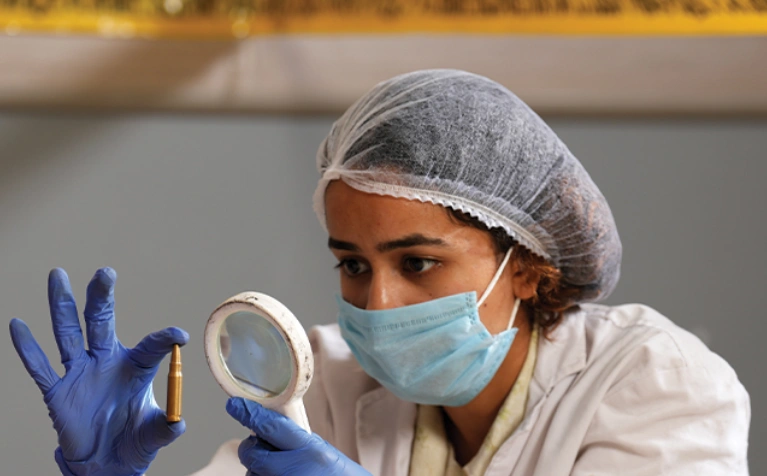
The M.Sc. in Forensic Science is a two-year (4-semester) postgraduate program designed to produce highly skilled, research-oriented forensic professionals equipped to meet the demands of modern criminal justice, national security, and scientific investigation systems.
It builds on undergraduate foundations with advanced theoretical knowledge, sophisticated laboratory techniques, and practical application of scientific methods to legal issues. The curriculum aligns with global standards emphasizing on core forensic topics, ethics, quality assurance, and research, which follows the DFSS guidelines, and practices with analytical depth, it integrates forensic biology, chemistry, physics, digital forensics, crime scene intelligence, and legal frameworks, while fostering critical thinking, evidence evaluation, and expert communication skills.
A strong research component (thesis/dissertation) prepares graduates for leadership roles, innovation, or doctoral studies. With state-of-the-art labs, industry collaborations and emphasis on ethical practice and emerging technologies (DNA profiling, toxicology, cyber forensics), the program ensures global acceptability and relevance in an increasingly complex forensic landscape. Graduates emerge as competent experts ready for high-stakes environments, contributing to truth-seeking, justice delivery, and scientific advancement worldwide.
Program Specialisation
Program Highlights
- Advanced Multidisciplinary Curriculum: In-depth coverage of forensic biology (DNA/serology), chemistry (instrumental analysis, toxicology), physics (ballistics, trace evidence), digital/computer forensics, crime scene reconstruction, and quality management which core requirements and international best practices.
- Research Excellence: Substantial thesis or dissertation work with faculty mentorship, promoting original contributions aligned with global research standards and preparing students for Ph.D. or R&D roles.
- Hands-On Practical Training: Extensive laboratory sessions, advanced instrumentation (e.g., spectroscopy, PCR), mock investigations, and simulations. Well-equipped facilities support evidence analysis, preservation, and interpretation.
- Legal, Ethical & Professional Focus: Modules on criminology, criminal law, expert testimony, ethics, and quality assurance (ISO-aligned) ensure graduates meet courtroom and international standards.
- Industry & Global Relevance: Collaborations with forensic Science lab and industry where internships, and exposure to real-world case studies done. Curriculum supports mobility and recognition in global forensic communities.
- Career & Leadership Preparation: Strong emphasis on problem-solving, communication, a
Programme Specific Outcome (PSO)
PSO 01
Advanced knowledge in Forensic Science Master advanced understanding of the fundamentals and techniques in areas such as DNA profiling and serology, forensic toxicology and chemistry, ballistics and trace evidence, digital forensics, and anthropological identification for reliable case resolution.
PSO 02
Problem solving and Critical Thinking Capability to extrapolate from what one has learned and apply their competencies to solve different kinds of non-familiar problems in examination of trace evidences, Crime scene investigation and their reporting.
PSO 03
Professional Development Graduates would expertise in successful careers based on their understanding of formal and practical skills of Forensic investigation in various sub discipline of Forensic Science like Anthropology, Questioned Documents, Fingerprint analysis, Forensic Serology, DNA fingerprinting, Cyber forensics, forensic ballistics, and the examination of physical evidences and the identification of suspect
Programme Educational Objectives (PEO)
Advanced Scientific Expertise
Provide in-depth knowledge and technical skills in forensic science disciplines (biology, chemistry, physics, digital) to enable accurate analysis and interpretation of evidence in legal and investigative contexts.
Research and Innovation
Foster the ability to conduct independent, high-quality research and contribute to advancements in forensic methodologies, tools, and applications.
Professional and Ethical Practice
Prepare graduates for leadership roles in forensic laboratories, law enforcement, policy, or academia while upholding the highest standards of ethics, integrity, quality assurance, and professional responsibility.
Interdisciplinary and Global Competence
Equip students to integrate scientific findings with legal systems, collaborate across disciplines, and address complex global challenges in forensic science (e.g., cybercrime, biotechnology, transnational investigations).
Lifelong Learning and Societal Impact
Promote continuous professional development and the application of forensic knowledge for justice, public safety, and societal benefit.
Programme Outcomes (PO)
Apply the knowledge of biology and basic science fundamentals to the solution and demonstrate comprehensive and advanced understanding of forensic science principles, theories, and their applications across multiple domains

Identify analyze complex scientific problems reaching substantiated conclusions using first principles of mathematics, natural sciences, and
Design solutions for complex scientific problems and design system components or processes that meet the specified needs with appropriate consideration for the public health and safety, and the cultural, societal, and environmental considerations.
Use research-based knowledge and research methods including design of experiments, analysis and interpretation of data, and synthesis of the information to provide valid conclusions.
Create, select, and apply appropriate techniques, resources, and modern sophisticated instruments and IT tools including for prediction and proactive forensic science and for complex and challenging activities in criminal investigation with an understanding of the limitations and quality assurance.
Apply reasoning informed by the contextual knowledge to assess societal, health, safety, legal and cultural issues and the consequent responsibilities relevant to the professional scientific practice.
Understand the impact of the professional scientific solutions in societal and environmental contexts, and demonstrate the knowledge of, and need for sustainable development.
Apply ethical principles and commit to professional ethics and responsibilities and norms of the scientific practice quality management systems, and legal standards in all aspects of forensic practice to ensure integrity and admissibility of evidence.
Function effectively as an individual, and as a member or leader in diverse teams, and in multidisciplinary settings.
Communicate effectively on complex engineering activities with the engineering community and with society at large, such as, being able to comprehend and write effective reports and design documentation, make effective presentations, and give and receive clear instructions.
Execute new ideas in the field of research and development using principles and techniques of science learned through activities such as expert lecturers, workshops, seminars and field projects.
Recognize the need for, and have the preparation and ability to engage in independent and life-long learning in the broadest context of technological change.
Curriculum Details
| Course Code | Course Title | L | T | P | Credits |
|---|---|---|---|---|---|
| FSC4801 | Fundamentals of Forensic Science | 3 | 0 | 0 | 3 |
| FSC4802 | Criminology & Criminal Law | 3 | 0 | 0 | 3 |
| FSC4101 | Basics of Computer Forensics | 3 | 0 | 0 | 3 |
| FSC4101L | Basics of Computer Forensics Lab | 0 | 0 | 2 | 1 |
| FSC4804 | Instrumental Analysis | 3 | 0 | 0 | 3 |
| FSC4805 | Quality management & Evidence evaluation | 3 | 0 | 0 | 3 |
| FSC4806 | Concepts of Forensic Physics | 3 | 0 | 0 | 3 |
| FSC4501 | Forensic Science Lab- I | 0 | 0 | 4 | 2 |
| SCI4701 | Clean room and vaccum Technology | 2 | 0 | 0 | 2 |
| Total Credits | 23 | ||||
| Course Code | Course Title | L | T | P | Credits |
|---|---|---|---|---|---|
| FSC4807 | Forensic Toxicology & Pharmacology | 3 | 0 | 0 | 3 |
| FSC4808 | Finger Prints and other Impressions | 3 | 0 | 0 | 3 |
| FSC4809 | Questioned Documents Analysis | 3 | 0 | 0 | 3 |
| FSC4810 | Forensic Chemistry and Explosives | 3 | 0 | 0 | 3 |
| FSC4811 | Forensic Ballistics | 3 | 0 | 0 | 3 |
| FSC4502 | Forensic Science Lab- II | 0 | 0 | 4 | 2 |
| FSC4504 | Forensic Science Practical Lab- III | 0 | 0 | 4 | 2 |
| FSC4505 | Forensic Science Practical Lab- IV | 0 | 0 | 4 | 2 |
| COM4501 | Scientific Paper Writing | 1 | 0 | 0 | 1 |
| Total Credits | 22 | ||||
| Course Code | Course Title | L | T | P | Credits |
|---|---|---|---|---|---|
| FSC5801 | Forensic Medicine & Pathology | 3 | 0 | 0 | 3 |
| FSC5802 | Forensic Serology and DNA Profiling | 3 | 0 | 0 | 3 |
| FSC5803 | Forensic Biology | 3 | 0 | 0 | 3 |
| FSC5504 | Forensic Science Practical Lab – V | 0 | 0 | 4 | 2 |
| FSC5505 | Forensic Science Practical Lab – VI | 0 | 0 | 4 | 2 |
| FSC5502 | Minor Project | 0 | 0 | 6 | 3 |
| DE-I | 3 | 0 | 0 | 3 | |
| DE-II | 3 | 0 | 0 | 3 | |
| Total Credits | 22 | ||||
| Course Code | Course Title | L | T | P | Credits |
|---|---|---|---|---|---|
| Open Elective | 3 | 0 | 0 | 3 | |
| FSC5503 | Major Project | 0 | 0 | 28 | 14 |
| Total Credits | 17 | ||||
| Course Code | Course Title |
|---|---|
| FSC5901 | Forensic Anthropology |
| FSC5902 | Arson & Explosions |
| FSC5903 | Forensic DNA Analysis |
| FSC5904 | Forensic Psychology |
| FSC5905 | Forensic Engineering |
Career Path
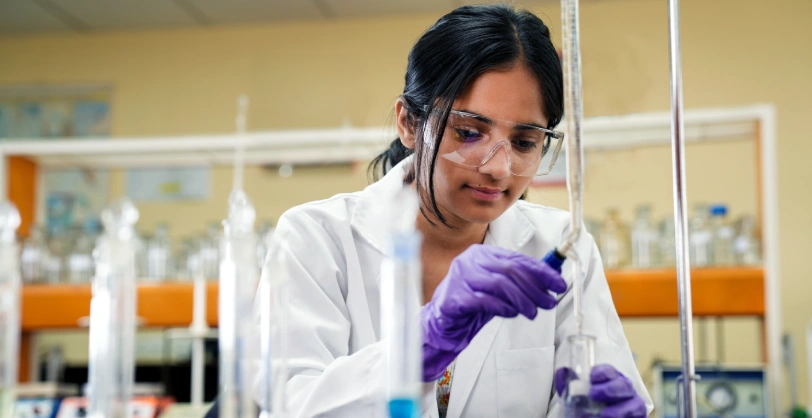
An M.Sc. in Forensic Science opens diverse, high-impact career opportunities in government, private, research, and international sectors. The program’s emphasis on advanced lab skills, research, ethics, and legal knowledge makes graduates highly employable in Central/State/Regional Forensic Science Labs, as Forensic Scientist/Analyst (e.g., in DNA, Toxicology, Chemistry, Ballistics, Trace Evidence, or Digital Forensics units). Police department and in CBI as Crime Scene Investigator/Forensic Investigator. Hospitals, Law Firms, Private sector Banks, research/academia, or expert roles in investigations.
Fee Structure
Yearly
| 1st Year | 2nd Year |
|---|---|
| ₹1,65,000 | ₹1,35,000 |
Semester Wise
| 1st Sem | 2nd Sem | 3rd Sem | 4th Sem |
|---|---|---|---|
| ₹97,500 | ₹67,500 | ₹67,500 | ₹67,500 |
Admission Process
Admission Process – Bachelor of Medical Radiology and Imaging Technology (BMRIT)
Complete application., Appear for entrance test and interview. Receive offer upon shortlisting. Admission Requirement: Qualifying B.Sc. as above + entrance/interview.
Admission Requirement
As per eligibility (B.Sc. degree in any Science graduates (10+2+3) like Forensic Science, life science, chemistry, physics , Medicine, typically with 50% aggregate). Marksheet and certificates of B.Sc., migration or transfer certificate, Character certificate, Medical Fitness certificate


 About Us