
B Tech in Mechanical Engineering (specialization in Electric Vehicles)
Duration4 Years
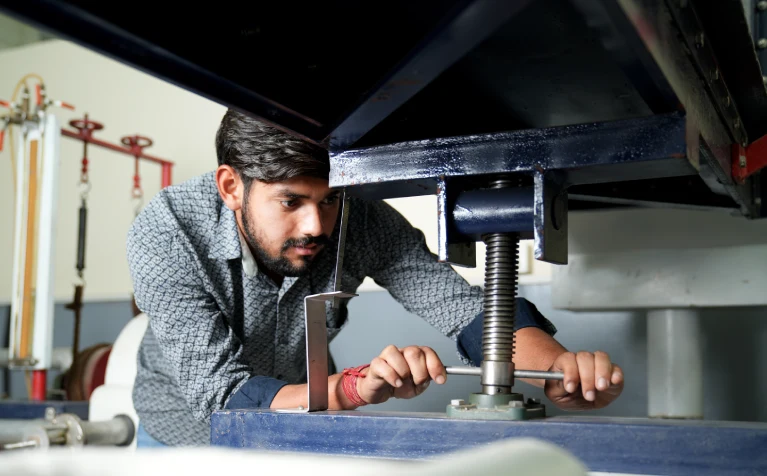
B Tech in Mechanical Engineering (specialization in Electric Vehicles)
Approved by All India Council of Technical Education, India is a challenging field that involves merging & intermingling with the skills of science & technology. This program is designed to attain a high level of contextual excellence in the arena of Engineering & Technology.
Program Specialisation
Program Overview
Theory, practical and applied subjects are undertaken in the course structure of this program; with crucial inputs by experts in the field of Engineering and Technology.
At the end of the Program, the students graduate with a strong foundation of multi-disciplinary skills related to environment friendly and sustainable design, construction techniques, space transformations and aesthetical features.
Program Highlights
- B.Tech in Mechanical Engineering (specialization in Electric Vehicles) is in collaboration with ICAT, Manesar
- Industry-aligned curriculum designed as per NEP 2020 guidelines.
- Modern laboratories are equipped with Electric drives, IC engines, CAD/CAM, CNC machining, and manufacturing facilities.
- Hands-on learning through workshops, live projects, industrial visits, and internships.
- Project-based learning from the third semester onwards.
- Professional certification opportunities in CAD/CAM, Electric Vehicles, MATLAB, ANSYS, Python and AI.
- Dedicated research opportunities in Electric Mobility, Sustainable Manufacturing, Robotics, Renewable Energy and Advanced Materials.
- Industry collaborations with ICAT.
- Capstone Project and Summer Internship in the final year.
- Excellent higher education opportunities in India and abroad.
PSO 01
To develop the ability to apply the concept of Mechanical Engineering for design, development, analysis and maintenance of Mechanical Systems and processes.
PSO 02
To apply the principles of Mechanical Engineering, Modeling and Simulation of Mechanical systems, Controlling of Mechanical systems, Digital manufacturing Science, Thermal Engineering, and Product Design for the industry readiness and advance research in academics.
PSO 03
Graduates would expertise in successful careers based on their understanding of formal and practical methods.
PEO 01
Graduates will establish successful careers in Mechanical Engineering and Electric Vehicle industries by applying engineering knowledge to solve real-world engineering problems.
PEO 02
Graduates will demonstrate leadership, teamwork, communication skills, professional ethics, and social responsibility in multidisciplinary environments.
PEO 03
Graduates will pursue higher education, research, entrepreneurship, and lifelong learning to adapt to rapidly evolving technologies.
PEO 04
Graduates will contribute towards sustainable engineering solutions focusing on clean energy, electric mobility, and environmentally responsible manufacturing.
Programme Outcomes (PO)
PROGRAM OUTCOMES (POs) of School of Engineering and Sciences: Students of all undergraduate Bachelor of Technology degree program at the time of graduation will have
Apply the knowledge of mathematics, science, engineering fundamentals, and an engineering specialization to the solution of complex engineering problems.

Identify, formulate, review research literature, and analyze complex engineering problems reaching substantiated conclusions using first principles of mathematics, natural sciences, and engineering sciences.
Design solutions for complex engineering problems and design system components or processes that meet the specified needs with appropriate consideration for the public health and safety, and the cultural, societal, and environmental considerations.
Use research-based knowledge and research methods including design of experiments, analysis and interpretation of data, and synthesis of the information to provide valid conclusions.
Create, select, and apply appropriate techniques, resources, and modern engineering and IT tools including prediction and modeling to complex engineering activities with an understanding of the limitations.
Apply reasoning informed by the contextual knowledge to assess societal, health, safety, legal and cultural issues and the consequent responsibilities relevant to the professional engineering practice.
Understand the impact of the professional engineering solutions in societal and environmental contexts, and demonstrate the knowledge of, and need for sustainable development.
Apply ethical principles and commit to professional ethics and responsibilities and norms of the engineering practice.
Function effectively as an individual, and as a member or leader in diverse teams, and in multidisciplinary settings.
Communicate effectively on complex engineering activities with the engineering community and with society at large, such as, being able to comprehend and write effective reports and design documentation, make effective presentations, and give and receive clear instructions.
Demonstrate knowledge and understanding of the engineering and management principles and apply these to one’s own work, as a member and leader in a team, to manage projects and in multidisciplinary environments.
Recognize the need for, and have the preparation and ability to engage in independent and life-long learning in the broadest context of technological change.
Curriculum Details
| S.No | Code | Course Type (Category) | Course Title | L | T | P | Total credits | (Category-NEP) |
|---|---|---|---|---|---|---|---|---|
| 1 | CSE1013/CSE1013L | ESC-I | Programming for Problem Solving | 2 | 0 | 2 | 3 | MIC |
| 2 | MAT1121 | BSC-I | Linear Algebra, Calculus and Ordinary Differential Equations | 3 | 1 | 0 | 4 | MIC |
| 3 | PHY1010/PHY1010L | BSC-II | Physics for Engineers | 3 | 0 | 2 | 4 | MIC |
| 4 | MEC1509 | ESC-II | Engineering Graphics | 0 | 0 | 4 | 2 | DSC |
| 5 | COM1531 | HSMC-I | Contemporary English | 0 | 0 | 4 | 2 | AEC |
| 6 | VAC001 | HSMC-II | Design Thinking | 2 | 0 | 0 | 2 | VAC |
| 7 | MEC1704 | PCC-I | Mechanical Systems and Electric Vehicle Technology | 2 | 0 | 0 | 2 | DSC |
| 8 | EGR1501 | AUC-I | Induction Program | 0 | 0 | 0 | 0 | |
| Semester Credit | 19 | |||||||
| S.No | Code | Course Type (Category) | Course Title | L | T | P | Total credits | (Category-NEP) |
|---|---|---|---|---|---|---|---|---|
| 1 | ELE1001/ELE1001L | ESC-III | Fundamentals of Electrical & Electronics Engineering | 3 | 0 | 2 | 4 | MIC |
| 2 | CHE1004/CHE1004L | BSC-III | Engineering Chemistry | 3 | 0 | 2 | 4 | MIC |
| 3 | MAT1122 | BSC-IV | Vector Calculus, Transforms and Partial Differential Equations | 3 | 1 | 0 | 4 | MIC |
| 4 | CSE1711 | ESC-IV | Artificial Intelligence and its Real-World Applications | 2 | 0 | 0 | 2 | MIC |
| 5 | VAC004 | HSMC-III | Introduction to Indian Knowledge system | 2 | 0 | 0 | 2 | VAC |
| 6 | MEC1702 | PCC-II | Mechanics for Engineers | 3 | 0 | 0 | 3 | DSC |
| 7 | COM1542 | HSMC-IV | Professional Skills & Ability Enhancement | 0 | 0 | 4 | 2 | AEC |
| 8 | LAW1010 | AUC-II | Introduction to Indian Constitution | 3 | 0 | 0 | 0 | MDC |
| Semester Credit | 21 | |||||||
| S.No | Code | Course Type (Category) | Course Title | L | T | P | Total credits | (Category-NEP) |
|---|---|---|---|---|---|---|---|---|
| 1 | CVL2011/CVL2011L | PCC-III | Strength of Materials | 3 | 0 | 2 | 4 | DSC |
| 2 | MAT2719 | BSC-V | Complex Analysis, Numerical Methods and Probability Distributions | 3 | 0 | 0 | 3 | MIC |
| 3 | MEC2013/MEC2013L | PCC-IV | Thermodynamics for Engineers | 3 | 0 | 2 | 4 | DSC |
| 4 | MEC2012/MEC2012L | PCC-V | Kinematics and Dynamics of Machinery | 3 | 0 | 2 | 4 | DSC |
| 5 | MEC1507 | ESC-V | Workshop Practice | 0 | 0 | 4 | 2 | DSC |
| 6 | UHV2701 | HSMC-V | Universal Human Values | 3 | 0 | 0 | 3 | MDC |
| 7 | IDP2501/IDP2502 | PROJ | Developing a Business Model/Research & Design | 0 | 0 | 6 | 3 | SEC |
| Semester Credit | 23 | |||||||
| S.No | Course Code | Course Type (Category) | Course Title | L | T | P | Total credits | (Category-NEP) |
|---|---|---|---|---|---|---|---|---|
| 1 | MEC2004/MEC2004L | PCC-VI | Fluid Mechanics | 3 | 0 | 2 | 4 | DSC |
| 2 | MEC2014/MEC2014L | PCC-VII | Electric Machine systems | 3 | 0 | 2 | 4 | DSC |
| 3 | EVE2010/EVE2010L | PCC-VIII | EV Manufacturing Technology | 3 | 0 | 2 | 4 | DSC |
| 4 | MEC2003/MEC2003L | PCC-IX | Instrumentation & Control Engineering | 3 | 0 | 2 | 4 | DSC |
| 5 | ENV1705 | AUC-III | Environmental Studies | 2 | 0 | 0 | 0 | VAC |
| 6 | IDP2503/IDP2504 | PROJ | Translating Business Model/ Data Analysis & Publication | 0 | 0 | 6 | 3 | SEC |
| Semester Credit | 19 | |||||||
| S.No | Code | Course Type (Category) | Course Title | L | T | P | Total credits | (Category-NEP) |
|---|---|---|---|---|---|---|---|---|
| 1 | MEC3701 | PCC-X | Design of Machine elements | 3 | 0 | 0 | 3 | DSC |
| 2 | EVE3716 | PCC-XI | Battery Technology | 3 | 0 | 0 | 3 | DSC |
| 3 | MEC3702 | PCC-XII | Industrial Engineering and Mangement | 3 | 0 | 0 | 3 | DSC |
| 4 | MEC2011/MEC2011L | PCC-XIII | Heat Transfer | 3 | 0 | 2 | 4 | DSC |
| 5 | ELX3008/ELX3008L | PCC-XIV | Microprocessor & Microcontrollers | 3 | 0 | 2 | 4 | MIC |
| 6 | MEC3703 | PCC-XV | Materials Science & Tribology | 3 | 0 | 0 | 3 | DSC |
| 7 | PEC-I | Professional Elective I | 3 | 0 | 0 | 3 | DSC | |
| Semester Credit | 23 | |||||||
| S.No | Course Code | Course Type (Category) | Course Title | L | T | P | Total credits | (Category-NEP) |
|---|---|---|---|---|---|---|---|---|
| 1 | EVE3008/EVE3008L | PCC-XVI | Automotive Embedded Systems | 3 | 0 | 2 | 4 | DSC |
| 2 | EVE3717 | PCC-XVII | Power Electronics & Drive | 3 | 0 | 0 | 3 | DSC |
| 3 | MEC3006/MEC3006L | PCC-XVIII | Refrigeration & Air-conditioning | 3 | 0 | 2 | 4 | DSC |
| 4 | PEC-II | Professional Elective II | 3 | 0 | 0 | 3 | DSC | |
| 5 | OEC-I | Open Elective-1 | 3 | 0 | 0 | 3 | MDC | |
| 6 | PEC-III | Professional Elective III | 3 | 0 | 0 | 3 | DSC | |
| Semester Credit | 20 | |||||||
| S.No | Code | Course Type (Category) | Course Title | L | T | P | Total credits | (Category-NEP) |
|---|---|---|---|---|---|---|---|---|
| 1 | MEC4707 | PCC-XIX | Vehicle Dynamics | 3 | 0 | 0 | 3 | DSC |
| 2 | PEC-IV | Professional Elective-IV | 3 | 0 | 0 | 3 | DSC | |
| 3 | PEC-V | Professional Elective-V | 3 | 0 | 0 | 3 | DSC | |
| 4 | OEC-II | Open Elective 2 | 3 | 0 | 0 | 3 | MDC | |
| 5 | EVE4001 | PCC-XX | EV Modeling and Simulation | 3 | 0 | 2 | 4 | DSC |
| 6 | EGR4501 | PROJ | Capstone Project Phase I | 0 | 0 | 0 | 4 | SEC |
| 7 | EGR4502 | PROJ | Summer Internship | 0 | 0 | 0 | 2 | SEC |
| Semester Credit | 22 | |||||||
| S.No | Course Code | Course Type (Category) | Course Title | L | T | P | Total credits | (Category-NEP) |
|---|---|---|---|---|---|---|---|---|
| 1 | OEC-III | Open Elective-3 | 3 | 0 | 0 | 3 | MDC | |
| 2 | EGR4503 | PROJ | Capstone Project Phase II | 0 | 0 | 0 | 10 | SEC |
| Semester Credit | 13 | |||||||
| Program Credit | 160 | |||||||
| S.No | Code | Category | Course | L | T | P | Total Credits |
|---|---|---|---|---|---|---|---|
| EV Charging Infrastructure | |||||||
| 1 | EVE3719 | EV Charging Technology | 3 | 0 | 0 | 3 | |
| 2 | EVE3720 | EV Infrastructure: Standards, Regulations & Safety Practices | 3 | 0 | 0 | 3 | |
| Mechanical Systems | |||||||
| 1 | MEC3717 | IC Engine | 3 | 0 | 0 | 3 | |
| 2 | MEC3718 | Composite Materials | 3 | 0 | 0 | 3 | |
| 3 | MEC3719 | Noise & Vibration | 3 | 0 | 0 | 3 | |
| 4 | MEC3810 | Computational Fluid Dynamics | 3 | 0 | 0 | 3 | |
| 5 | MEC2704 | Power Plant Engineering | 3 | 0 | 0 | 3 | |
| 6 | MEC3005 | CAD/CAM | 2 | 0 | 2 | 3 | |
| EV Motor Design & Control | |||||||
| 1 | EVE3721 | Advanced Motor Control Techniques | 3 | 0 | 0 | 3 | |
| 3 | EVE3722 | Inspect, test and implement the Motor and Transmission Control system | 3 | 0 | 0 | 3 | |
| 4 | EVE3721 | Protective Relaying | 3 | 0 | 0 | 3 | |
| Industry 4.0 | |||||||
| 1 | CSE2001 | Data Structures & Algorithms | 3 | 0 | 0 | 3 | |
| 2 | MEC3711 | Robotics and Robot Applications | 3 | 0 | 0 | 3 | |
| 3 | CSE3803 | Introduction to Data Science | 3 | 0 | 0 | 3 | |
| 4 | CSE4712 | Machine Learning | 3 | 0 | 0 | 3 | |
| 5 | CSE2501 | Introduction to Internet of Things | 3 | 0 | 0 | 3 | |
| 6 | CSE2714 | Introduction to Cloud Computing | 3 | 0 | 0 | 3 | |
| 7 | CSE2022 | Artificial Intelligence Techniques and Methods | 3 | 0 | 0 | 3 | |
| S.No | Code | Category | Course Title | L | T | P | Total Credits |
|---|---|---|---|---|---|---|---|
| 1 | TRC1501 | AUC | Career and Professional Readiness Program I | 2 | 0 | 0 | 0 |
| 2 | TRC1502 | AUC | Career and Professional Readiness Program II | 2 | 0 | 0 | 0 |
| 3 | TRA2503 | AUC | Aptitude building and Placement Readiness Program - I | 2 | 0 | 0 | 0 |
| 4 | TRA2504 | AUC | Aptitude building and Placement Readiness Program - II | 2 | 0 | 0 | 0 |
| 5 | TRC3501 | AUC | Career and Professional Readiness Program III | 2 | 0 | 0 | 0 |
| 6 | TRA3501 | AUC | Career Readiness and Skill Advancement Program | 2 | 0 | 0 | 0 |
| S.No | Code | Category | Course Title | L | T | P | Total Credits |
|---|---|---|---|---|---|---|---|
| 1 | SES1503 | AUC | Basic Workshop & Repair skills for daily Life | 0 | 0 | 2 | 0 |
Career Path

Graduates of B.Tech in Mechanical Engineering (Specialization in Electric Vehicles) have excellent career opportunities across automotive, manufacturing, energy, robotics, and electric mobility sectors. They can pursue careers as:
- Mechanical Design Engineer
- Electric Vehicle Engineer
- Manufacturing Engineer
- Production Engineer
- Automotive Engineer
- Quality Engineer
- Maintenance Engineer
- Thermal Engineer
- CAD/CAM Engineer
- CAE Simulation Engineer
- Vehicle Dynamics Engineer
- Product Development Engineer
- Research & Development Engineer
- Industrial Engineer
- Supply Chain Engineer
- Project Engineer
- Data Analyst for Smart Manufacturing
Higher Education Opportunities
- M.Tech
- MS (India & Abroad)
- MBA
- Ph.D
- Research Fellowships
- Government Engineering Services
- PSU Recruitment
- Civil Services
Eligibility
Only candidates who have the following credentials shall be eligible for admission to B.Tech. Course.
a) Passed 10+2 examination with Physics and Mathematics as compulsory course and any one course from Chemistry/ Computer Science/Electronics/Information Technology/ Biology/Informatics Practices/ Biotechnology/ Technical Vocational subject/ Agriculture/ Engineering Graphics/ Business Studies/Entrepreneurship.
b) Obtained at least 50% marks in the above 2 compulsory and any one selected (from list of 12) subjects taken together.
Passed min. 3 years Diploma examination with at least 50% marks


 About Us