
Integrated M.Sc. in Clinical Embryology
Duration5 Years
Course Fee8.30 Lakhs
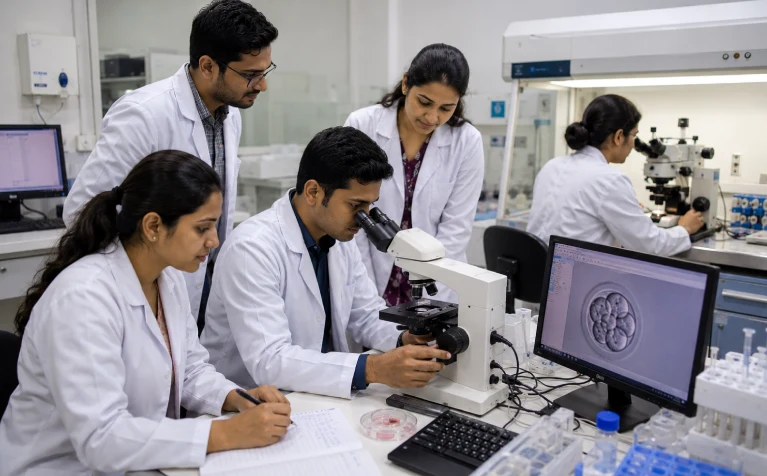
Integrated M.Sc. in Clinical Embryology.
The Integrated M.Sc. in Clinical Embryology is an advanced, multi-year academic programme designed to provide seamless, comprehensive training from undergraduate foundational sciences to specialized postgraduate reproductive medicine.
This comprehensive curriculum bridges the gap between core biomedical sciences—such as cell biology, genetics, and endocrinology—and the highly technical, hands-on applications of assisted reproductive technology (ART).
Program Specialisation
Overview
Students gain intensive theoretical knowledge alongside rigorous laboratory training in crucial reproductive procedures, including semen analysis, in vitro fertilization (IVF), intracytoplasmic sperm injection (ICSI), cryopreservation, and embryo culture.
Beyond the technical mechanics of the laboratory, the coursework deeply integrates modules on bioethics, quality control, and reproductive law, ensuring that graduates understand the strict regulatory frameworks governing fertility treatments. By eliminating the transition gap between a standard bachelor's degree and a master's degree, this integrated pathway rapidly equips students with the specialized skills needed for modern clinical practice. Graduates are highly prepared to excel as clinical embryologists, fertility researchers, lab directors, or consultants in IVF clinics, hospitals, and reproductive research facilities worldwide.
Highlighs
- Continuous dual degree: Combines both undergraduate and postgraduate education into a single, seamless five-year program right after school.
- Direct entry post-12th: Allows immediate enrollment after completing 10+2 Science with Physics, Chemistry, and Biology.
- NEET qualification exempt: Opens a direct career path into specialized healthcare without requiring NEET clearance.
- Comprehensive curriculum: Blends basic Life Sciences with advanced molecular biology, human genetics, and reproductive medicine.
- Advanced ART exposure: Focuses deeply on specialized Assisted Reproductive Technology workflows like IVF and ICSI.
- Hands-on micromanipulation: Provides rigorous laboratory training in gamete handling, semen analysis, and embryo grading.
- Cryopreservation expertise: Teaches essential clinical skills for freezing and thawing eggs, sperm, and reproductive tissues.
- Immersive clinical postings: Features mandatory internships and hospital rotations inside real-world fertility clinics.
- Bioethics and regulation: Covers crucial legal frameworks, medical ethics, and quality control guidelines for laboratories.
- Diverse career avenues: Prepares graduates to work immediately as clinical embryologists, lab managers, or fertility researchers.
Programme Specific Outcome (PSO)
PSO 01
Build a strong foundation in cell biology, genetics, and molecular biochemistry before advancing to specialized ART training.
PSO 02
Gain hands-on competence in operating micromanipulators, inverted microscopes, and automated liquid handling systems.
PSO 03
Analyse genetic screening methodologies like PGT-A, PGT-M, and karyotyping used in pre-implantation genetic testing. [1]
PSO 04
Master advanced sperm processing techniques including density gradient centrifugation and microscopic assessment for morphological defects.
PSO 05
Formulate and maintain precise culture media environments tailored to specific stages of pre-implantation embryo development.
PSO 06
Execute rapid freezing protocols using vitrification technologies to maximize post-thaw survival rates of eggs and embryos.
PSO 07
Operate and calibrate specialized gas incubators, laminar flow hoods, and anti-vibration tables to ensure cleanroom safety.
PSO 08
Troubleshoot micro-environmental shifts, contamination events, and equipment failure loops inside the embryology suite instantly.
PSO 09
Maintain meticulous records of inventory, donor validation tracking, and cryopreservation data in alignment with regulatory guidelines.
PSO 10
Demonstrate competency in performing laser-assisted hatching and cellular biopsy procedures under strict quality control standards.
Programme Educational Objectives (PEO)
PEO 01
Provide a seamless, structured transition from basic undergraduate biological sciences to highly specialized postgraduate embryology frameworks.
PEO 02
Produce competent diagnostic professionals capable of handling automated clinical biochemistry and specialized reproductive assays.
PEO 03
Cultivate an entrepreneurial and administrative mindset to set up and operate commercial fertility ventures and diagnostic franchises.
PEO 04
Equip graduates with multi-disciplinary skills to collaborate effectively with medical, legal, and operational stakeholders.
PEO 05
Cultivate advanced capabilities in precision micromanipulation procedures like Intracytoplasmic Sperm Injection (ICSI) and embryo biopsy.
PEO 06
Foster global competence in maintaining stringent quality control, cleanroom standards, and laboratory auditing systems.
PEO 07
Train professionals to adhere strictly to national and international legal frameworks and ethical guidelines governing reproductive medicine.
PEO 08
Prepare graduates to lead scientific research, clinical trials, and innovations in reproductive technologies and genetic testing.
PEO 09
Instill life-long learning habits to adapt quickly to emerging advancements like artificial intelligence in embryo selection.
PEO 10
Develop empathetic and professional communication skills necessary for patient counseling and cross-functional clinical teamwork.
Programme Outcomes (PO)
Connect core biological principles with applied clinical embryology workflows effectively.

Diagnose laboratory errors, mechanical faults, and media contamination loops proactively.
Master Laboratory Information Management Systems (LIMS) and electronic medical record platforms
Explain technical diagnostic results clearly to medical clinicians, patients, and legal auditors.
Execute safe medical waste disposal, hazard management, and eco-friendly laboratory protocols.
Perform advanced micromanipulation techniques, including Intracytoplasmic Sperm Injection (ICSI) and embryo biopsy, with precision.
Execute standard protocols for the vitrification and ultra-low temperature preservation of gametes and embryonic tissues.
Monitor cleanroom air quality, temperature regulations, and gas concentrations to maintain optimal culture environments.
Navigate complex legal frameworks, regulatory statutes, and reproductive healthcare biomedical ethics responsibly.
Design independent experimental protocols to investigate current challenges in reproductive biology and fertility treatments.
Curriculum Details
| Paper Code | Course Title | L | T | P | Credits | TI | TE | PI | PE | Total |
|---|---|---|---|---|---|---|---|---|---|---|
| ICE101T | Fundamental of Cellular Biology | 3 | 1 | 0 | 4 | 30 | 70 | - | --- | 100 |
| ICE102T | Fundamental of Reproductive Sciences | 3 | 1 | 0 | 4 | 30 | 70 | --- | 100 | |
| ICE103T | Basics of Microbiology | 3 | 1 | 0 | 4 | 30 | 70 | 100 | ||
| ICE104T | Introduction to Clinical Embryology | 2 | 1 | 0 | 3 | 25 | 50 | - | - | 75 |
| ICE105P | Hands on Demonstration -clinical Embryology Lab | 0 | 0 | 4 | 2 | - | 1 | 15 | 35 | 50 |
| ICE106P | Hands on Demonstration -cell Biology and Microbiology Lab | 0 | 0 | 6 | 3 | - | - | 25 | 50 | 75 |
| Total | 12 | 5 | 10 | 22 | 550 | |||||
| Paper Code | Course Title | L | T | P | Credits | TI | TE | PI | PE | Total |
|---|---|---|---|---|---|---|---|---|---|---|
| ICE201T | Human Anatomy and Physiology | 3 | 1 | 0 | 4 | 30 | 70 | - | - | 100 |
| ICE202T | Fundamentals of Biochemistry and Metabolism | 3 | 1 | 0 | 4 | 30 | 70 | - | - | 100 |
| ICE203T | Basics of Genetics | 3 | 1 | 0 | 4 | 30 | 70 | - | - | 100 |
| ICE204T | Infertility and Assisted Reproduction | 2 | 1 | 0 | 3 | 25 | 50 | - | - | 75 |
| ICE205T | Physiology and Genetics Lab | 0 | 0 | 4 | 2 | - | - | 15 | 35 | 50 |
| ICE206T | Biochemistry Lab | 0 | 0 | 6 | 3 | - | - | 25 | 50 | 75 |
| ICE207T | Environmental studies | 2 | 0 | 0 | 2 | 15 | 35 | - | - | 50 |
| Total | 13 | 4 | 10 | 22 | 550 | |||||
| Paper Code | Course Title | L | T | P | Credits | TI | TE | PI | PE | Total |
|---|---|---|---|---|---|---|---|---|---|---|
| ICE301T | Advanced and Modern Genetics | 3 | 1 | 0 | 4 | 30 | 70 | - | - | 100 |
| ICE302T | Development Biology | 3 | 1 | 0 | 4 | 30 | 70 | - | - | 100 |
| ICE303T | Immunology | 3 | 1 | 0 | 4 | 30 | 70 | - | - | 100 |
| ICE304T | Introduction to Assisted Reproductive Technology (ART) | 2 | 1 | 0 | 3 | 25 | 50 | - | - | 75 |
| ICE305T | Developmental Biology Lab | 0 | 0 | 4 | 2 | - | - | 15 | 35 | 50 |
| ICE306T | Laboratory Sterilization Techniques | 0 | 0 | 6 | 3 | - | - | 25 | 50 | 75 |
| ICE307T | Entrepreneurship and Leadership | 1 | 1 | 0 | 2 | 15 | 35 | 50 | ||
| Total | 12 | 5 | 10 | 22 | 550 | |||||
| Paper Code | Course Title | L | T | P | Credits | TI | TE | PI | PE | Total |
|---|---|---|---|---|---|---|---|---|---|---|
| ICE401T | Gametogenesis | 3 | 1 | 0 | 4 | 30 | 70 | - | - | 100 |
| ICE402T | Principles of Embryology | 3 | 1 | 0 | 4 | 30 | 70 | - | - | 100 |
| ICE403T | Biophysical Techniques | 3 | 1 | 0 | 4 | 30 | 70 | - | - | 100 |
| ICE404T | Advanced Microbiology | 3 | 1 | 0 | 4 | 30 | 70 | - | - | 100 |
| ICE405P | Gamete Biology and Biophysical Techniques Lab | 0 | 0 | 8 | 4 | - | - | 30 | 70 | 100 |
| ICE406P | Gametogenesis Lab | 0 | 0 | 4 | 2 | - | - | 15 | 35 | 50 |
| ICE407T | Counselling and Negotiation Skills | 1 | 1 | 0 | 2 | 15 | 35 | - | - | 50 |
| Total | 13 | 5 | 12 | 24 | 600 | |||||
| Paper Code | Course Title | L | T | P | Credits | TI | TE | PI | PE | Total |
|---|---|---|---|---|---|---|---|---|---|---|
| ICE501T | Clinical Embryology II | 3 | 1 | 0 | 4 | 30 | 70 | - | - | 100 |
| ICE502T | Reproductive Anatomy | 3 | 1 | 0 | 4 | 30 | 70 | - | - | 100 |
| ICE503T | Bioethics and Reproductive Law | 3 | 1 | 0 | 4 | 30 | 70 | - | - | 100 |
| ICE504T | Fundamentals of Molecular Biology | 3 | 1 | 0 | 4 | 30 | 70 | - | - | 100 |
| ICE505P | Molecular Biology Lab | 0 | 0 | 8 | 4 | - | - | 30 | 70 | 100 |
| ICE506P | Internship (Clinical /Lab Training) | - | - | - | 4 | - | - | - | - | |
| Total | 12 | 4 | 80 | 24 | 500 | |||||
| Paper Code | Course Title | L | T | P | Credits | TI | TE | PI | PE | Total |
|---|---|---|---|---|---|---|---|---|---|---|
| ICE601T | Embryo culture and in vitro conditions | 3 | 1 | 0 | 4 | 30 | 70 | - | - | 100 |
| ICE602T | Reproductive Endocrinology and Hormonal Regulation | 3 | 1 | 0 | 4 | 30 | 70 | - | - | 100 |
| ICE603P | Laboratory Quality Management and Accreditation | 3 | 1 | 0 | 4 | 30 | 70 | - | - | 100 |
| ICE604T | Development Biology II | 3 | 1 | 0 | 4 | 30 | 70 | - | 100 | |
| ICE605P | Endocrinology Lab | 0 | 0 | 8 | 4 | 30 | 70 | 100 | ||
| ICE606T | Artificial Intelligence on Assisted Reproduction | 1 | 1 | 0 | 2 | 15 | 35 | - | - | 50 |
| Total | 13 | 5 | 8 | 22 | 550 | |||||
| Paper Code | Course Title | L | T | P | Credits | TI | TE | PI | PE | Total |
|---|---|---|---|---|---|---|---|---|---|---|
| ICE701T | Infertility and Reproductive Disorder: overview and Management | 3 | 1 | 0 | 4 | 30 | 70 | - | - | 100 |
| ICE702T | Basic Andrology and Laboratory Techniques | 3 | 1 | 0 | 4 | 30 | 70 | - | - | 100 |
| ICE703T | Reproductive Biology and Reproductive Anatomy | 3 | 1 | 0 | 4 | 30 | 70 | - | - | 100 |
| ICE704T | Cell and Molecular Biology | 3 | 1 | 0 | 4 | 30 | 70 | - | - | 100 |
| ICE705T | Environmental Biology and Basic Endocrinology | 3 | 1 | 0 | 4 | 30 | 70 | - | - | 100 |
| ICE706P | Advanced Andrology: Semen Analysis, Functional Testing and Case Applications | 0 | 0 | 8 | 4 | - | - | 30 | 70 | 100 |
| Total | 15 | 5 | 8 | 24 | 600 | |||||
| Paper Code | Course Title | L | T | P | Credits | TI | TE | PI | PE | Total |
|---|---|---|---|---|---|---|---|---|---|---|
| ICE801T | Human Physiology and Endocrinology | 3 | 1 | 0 | 4 | 30 | 70 | - | - | 100 |
| ICE802T | Assisted Reproduction and Basic Embryology | 3 | 1 | 0 | 4 | 30 | 70 | - | - | 100 |
| ICE803T | Reproductive Immunology | 3 | 1 | 0 | 4 | 30 | 70 | - | - | 100 |
| ICE804T | Biochemistry and Biophysics in ART | 3 | 1 | 0 | 4 | 30 | 70 | - | - | 100 |
| ICE805T | Ethics and Legal Framework in ART | 3 | 1 | 0 | 4 | 30 | 70 | - | - | 100 |
| ICE806P | Advanced Embryology Laboratory – Media Handling, Oocyte and Embryo Culture | 0 | 0 | 8 | 4 | - | - | 30 | 70 | 100 |
| Total | 15 | 5 | 8 | 24 | 600 | |||||
| Paper Code | Course Title | L | T | P | Credits | TI | TE | PI | PE | Total |
|---|---|---|---|---|---|---|---|---|---|---|
| ICE901T | Cryobiology and ART | 3 | 1 | 0 | 4 | 30 | 70 | - | - | 100 |
| ICE902T | Micromanipulation and Preimplantation Genetics | 3 | 1 | 0 | 4 | 30 | 70 | - | - | 100 |
| ICE903T | Advanced Clinical Embryology Environmental Biology and TQM in ART | 3 | 1 | 0 | 4 | 30 | 70 | - | - | 100 |
| ICE904T | Advanced Micromanipulation and cryopreservation Techniques | 0 | 0 | 8 | 4 | - | - | 30 | 70 | 100 |
| ICE905T | Advanced Laboratory and Quality-Control Methods | 1 | 1 | 0 | 2 | 15 | 35 | - | - | 50 |
| ICE906P | Seminar | 0 | 0 | 4 | 2 | - | - | 15 | 35 | 50 |
| Total | 10 | 4 | 8 | 20 | 500 | |||||
| Paper Code | Course Title | L | T | P | Credits | TI | TE | PI | PE | Total |
|---|---|---|---|---|---|---|---|---|---|---|
| ICE1001T | Research Methodology and Biostatics | 3 | 1 | 0 | 4 | 30 | 70 | - | - | 100 |
| ICE1002T | Scientific Writing and Communication | 3 | 1 | 0 | 4 | 30 | 70 | - | - | 100 |
| ICE1003T | Dissertation / Research Project | - | - | - | 12 | - | - | - | 300 | 300 |
| Total | 6 | 2 | 20 | 500 | ||||||
Career Path

- Junior embryologist Starts in fertility clinics handling routine semen analysis, preparation, and basic laboratory maintenance.
- Senior embryologist Manages complex procedures like IVF, ICSI, laser assisted hatching, and embryo biopsies.
- Lab director Oversees entire IVF laboratory operations, quality control, regulatory compliance, and staff management.
- Andrologist Specializes strictly in male reproductive health, sperm processing, and fertility diagnostics.
- Cryobank manager Supervizes the safe freezing, storage, and inventory of eggs, sperm, and embryos.
- Fertility researcher Works in R&D labs developing new reproductive technologies or improving culture media.
- Application specialist Represents biomedical companies to train medical staff on advanced laboratory equipment.
- Academics professor Teaches reproductive biology and embryology courses at medical colleges or universities.
- Medical consultant Advises medical tech firms on the design and workflow of modern IVF clinics.
Fee Structure
Yearly
| 1st Year | 2nd Year | 3rd Year | 4th Year | 5th Year |
|---|---|---|---|---|
| ₹1,98,000 | ₹1,58,000 | ₹1,58,000 | ₹1,58,000 | ₹1,58,000 |
Fee Semester Wise
| 1st Sem | 2nd Sem | 3rd Sem | 4th Sem | 5th Sem | 6th Sem | 7th Sem | 8th Sem | 9th Sem | 10th Sem |
|---|---|---|---|---|---|---|---|---|---|
| ₹1,19,000 | ₹79,000 | ₹79,000 | ₹79,000 | ₹79,000 | ₹79,000 | ₹79,000 | ₹79,000 | ₹79,000 | ₹79,000 |
Eligibility
10+2 (Physics, Chemistry, and Biology). Candidates generally need a minimum aggregate score of 50% marks (45% for reserved categories) from a recognized board. NEET qualification is not mandatory.
Admission Process
Admission to the 5-year Integrated M.Sc. in Clinical Embryology at GD Goenka University requires candidates to have passed 10+2 with Physics, Chemistry, and Biology (PCB) from a recognized board.
Applicants must complete the online application form and pay the registration fee through the university admissions portal. Selection is based on academic merit and may include the Goenka Aptitude Test for Admission (GATA) and a Personal Interview (PI). Shortlisted candidates must complete document verification (10th & 12th mark sheets, Aadhaar/valid ID, and passport-sized photographs) and pay the prescribed admission fee to confirm their seat.
Frequently Asked Questions
It is a continuous five-year program that combines both Bachelor’s and Master’s degrees into a single curriculum directly after high school.
Students who have passed 10+2 Science with Physics, Chemistry, and Biology (PCB) from a recognized educational board.
No, qualifying for NEET is not mandatory to secure admission into this integrated program.
Most universities require a minimum aggregate score of 50% marks (45% for reserved categories) in PCB subjects.
The course covers human genetics, molecular biology, andrology, Assisted Reproductive Technology (ART), IVF laboratory workflows, and bioethics.
Yes, students undergo rigorous practical training in gamete handling, semen analysis, embryo grading, and micromanipulation techniques.
Yes, the final year typically includes a mandatory clinical internship or hospital posting inside an active fertility center.
Graduates can work as junior embryologists, andrologists, cryobank managers, IVF lab technicians, or fertility researchers.
Early exit options depend entirely on whether the university implements the National Education Policy (NEP) guidelines allowing a 3-year B.Sc. exit.
The career scope is expanding rapidly due to rising global infertility rates and a growing demand for skilled professionals in IVF clinics.


 About Us