
Master of Public Health (MPH)
Duration2 Years
Course Fee2.64 Lakhs
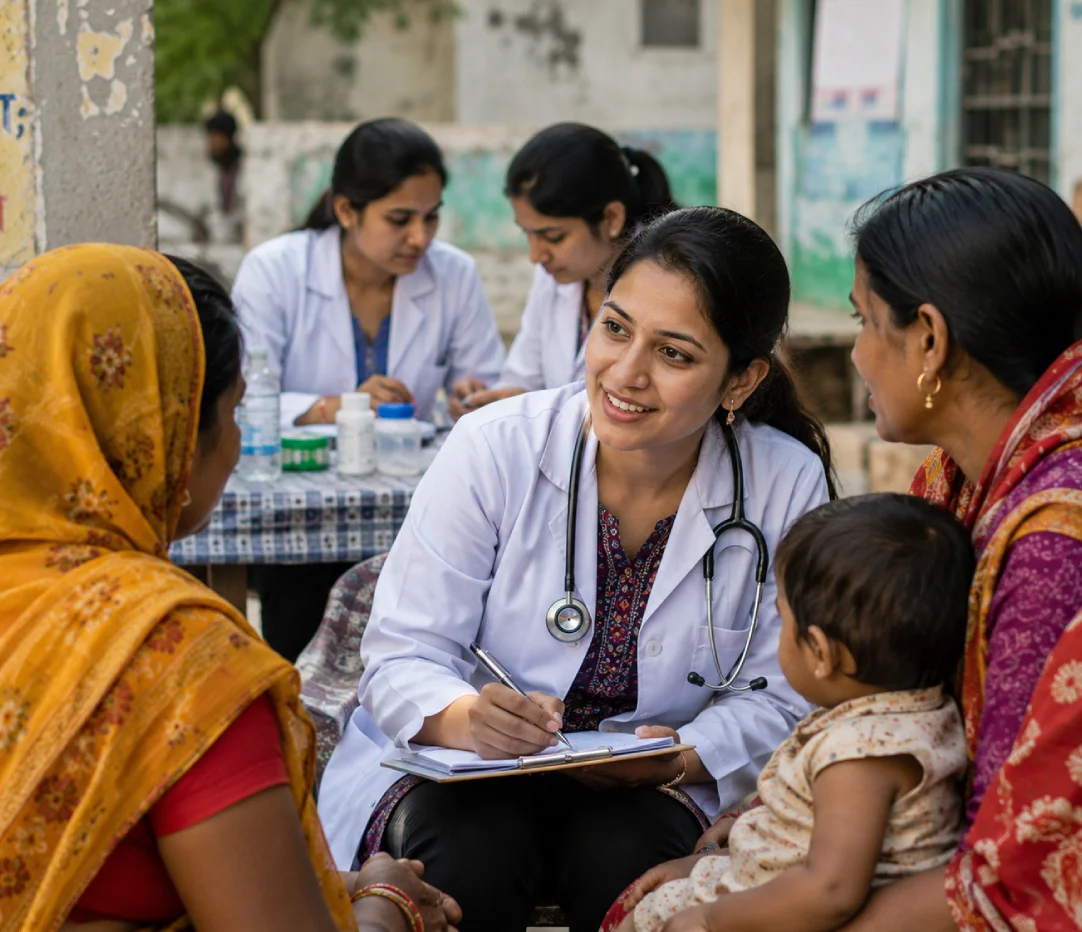
The Master of Public Health (MPH) programme at GD Goenka University is a multidisciplinary postgraduate programme designed to prepare future public health professionals capable of addressing emerging health challenges through evidence-based practice, research, policy, and leadership. The programme combines classroom learning with field-based training, internships, research projects, and community engagement to equip students with the knowledge and practical skills required to improve population health and strengthen healthcare systems.
Program Specialisation
Program Highlights
- Multidisciplinary curriculum aligned with national and global public health priorities.
- Extensive field exposure through internships, community projects, and public health surveys.
- Specialized training in Epidemiology, Biostatistics, Health Systems Management, Health Policy, Environmental Health, and Research.
- Research-oriented learning with dissertation and field practicum.
- Workshops, seminars, guest lectures, and interactions with public health experts.
- Career-oriented training in programme planning, monitoring, evaluation, and leadership.
Programme Specific Outcomes (PSO)
PSO 01
Public Health Research and Analytical Competence Apply epidemiological, biostatistical, and research methodologies to investigate public health problems, generate evidence, and support informed decision-making.
PSO 02
Public Health Programme Planning and Policy Design, implement, monitor, and evaluate public health programmes and interventions while analyzing health systems and policies to improve population health outcomes.
PSO 03
Leadership, Ethics, and Community Health Practice Demonstrate leadership, professional ethics, effective communication, and multidisciplinary collaboration to promote health equity, disease prevention, and sustainable public health practices at local, national, and global levels.
Program Educational Objectives (PEOs)
PEO 01
Develop competencies to improve population health through evidence-based interventions.
PEO 02
Apply research and analytical skills to public health practice and policymaking.
PEO 03
Demonstrate ethical leadership, communication, and teamwork.
PEO 04
Contribute to disease prevention, health promotion, and healthcare system strengthening.
PEO 05
Engage in lifelong learning and professional development.
Programme Outcomes (PO)
After successful completion of the programme, graduates will be able to:
Apply fundamental concepts, theories, and principles of public health to address community and population health challenges.

Utilize epidemiological methods and biostatistical tools to design, analyze, and interpret public health research and evidence-based interventions.
Plan, implement, monitor, and evaluate public health programmes and policies to improve health outcomes effectively.
Design and conduct ethical public health research, critically evaluate scientific evidence, and contribute to innovation in healthcare.
Develop and implement strategies for health promotion, disease prevention, health education, and behavior change across diverse populations.
Demonstrate leadership, interdisciplinary collaboration, teamwork, and effective management skills in public health practice.
Communicate public health information, research findings, and policy recommendations effectively to professionals, policymakers, and the community.
Adhere to ethical principles, professional standards, legal regulations, and social responsibility in public health practice and research.
Analyze healthcare systems, public health policies, and governance frameworks to strengthen health service delivery and policy implementation.
Promote health equity, social justice, environmental sustainability, and culturally appropriate interventions to reduce health disparities.
Engage in lifelong learning, critical thinking, digital health technologies, and continuous professional development to address emerging public health challenges.
Curriculum Details
| Course Code | Course Title | L | T | P | Credit |
|---|---|---|---|---|---|
| PBH1701 | Introduction to Health Systems and Policy in Developing Countries | 4 | 0 | 0 | 4 |
| PBH1702 | Principles and Practice of Public Health | 3 | 0 | 0 | 3 |
| PBH 1703 | Health Management: Management Principles and Practices (Strategic management) and Introduction to Operational Research | 4 | 0 | 0 | 4 |
| PBH1001 | Basic Epidemiology including Communicable and Non communicable Disease | 4 | 0 | 2 | 5 |
| PBH1002 | Basic Biostatistics | 4 | 0 | 2 | 5 |
| PBH1704 | Health Promotion Approaches and Methods | 3 | 0 | 0 | 3 |
| PBH1705 | Introduction to Health Programme Design andEvaluation | 5 | 0 | 0 | 5 |
| Total | 29 | ||||
| Course Code | Course Title | L | T | P | Credit |
|---|---|---|---|---|---|
| PBH1801 | Demography and Population Sciences | 3 | 0 | 0 | 3 |
| PBH1802 | Research Methodology | 5 | 0 | 0 | 5 |
| PBH1803 | Introduction to Financial Management and Budgeting | 4 | 0 | 0 | 4 |
| PBH1804 | Introduction to Health Economics | 3 | 0 | 0 | 3 |
| PBH1805 | Social and Behaviour change, Effective Communication Skills in Healthcare | 3 | 0 | 0 | 3 |
| PBH1806 | Reproductive Health and Family Planning | 3 | 0 | 0 | 3 |
| PBH1807 | Environmental and Occupational Health | 3 | 0 | 0 | 3 |
| PBH1808 | Laws and Ethics in Public Health | 3 | 0 | 0 | 3 |
| PBH1809 | Role of Alternative Medicines in Public Health | 2 | 0 | 0 | 2 |
| Total | 29 | ||||
| PBH1501* | Internship | 200 h | 6 | ||
| *Internship to be completed during the summer vacation for two months after the completion of second semester exams. | |||||
| S. No. | Specialization | Code | |||
|---|---|---|---|---|---|
| List of MPH Specializations and their code | |||||
| Elective | Epidemiology | MPE | |||
| Elective Stream 2 | Program Policy and Planning | MPP | |||
| Elective Stream 3 | Health Management | MHM | |||
| Elective Stream 4 | Reproductive Health and Family Planning | MRH | |||
| Elective Stream 1 – Epidemiology | |||||
| Course Code | Course Title | L | T | P | Credits |
| MPE2701 | Advanced Biostatistics | 4 | 0 | 0 | 4 |
| MPE2702 | Advanced Epidemiology | 4 | 0 | 0 | 4 |
| MPE2703 | Survey Design and Methods | 4 | 0 | 0 | 4 |
| MPE2704 | Infectious Disease Epidemiology including live Outbreak Investigation | 4 | 0 | 0 | 4 |
| MPE2705 | NCD Epidemiology | 4 | 0 | 0 | 4 |
| TOTAL | 20 | ||||
| Elective Stream 2- Program Policy and Planning | |||||
| Course Code | Course Title | L | T | P | Credits |
| MPP2701 | Health Policy, Process and Planning | 4 | 0 | 0 | 4 |
| MPP2702 | Programme Planning and Evaluation of Public Health Programmes | 4 | 0 | 0 | 4 |
| MPP2703 | Translating Research into Policy and Health Advocacy | 4 | 0 | 0 | 4 |
| MPP2704 | Current Issues in Health Policy: National and global perspective | 4 | 0 | 0 | 4 |
| MPP2705 | Role of Non-Governmental Organizations in Health Care | 4 | 0 | 0 | 4 |
| TOTAL | 20 | ||||
| Elective Stream 3-Health Management | |||||
| Course Code | Course Title | L | T | P | Credits |
| MHM2701 | Strategic Management in Health care and Entrepreneurship in Healthcare | 4 | 0 | 0 | 4 |
| MHM2702 | Advanced Operational research | 4 | 0 | 0 | 4 |
| MHM2703 | Advanced Financial management and Budgeting | 4 | 0 | 0 | 4 |
| MHM2704 | Organizational Management and Services | 4 | 0 | 0 | 4 |
| MHM2705 | Effective Communication in Public Health | 4 | 0 | 0 | 4 |
| TOTAL | 20 | ||||
| Elective Stream 4- Reproductive, Maternal, Neonatal, Child and Adolescent Health | |||||
| Course Code | Course Title | L | T | P | Credits |
| MRH2701 | Sexual and Reproductive Health | 4 | 0 | 0 | 4 |
| MRH2702 | Advanced Maternal and Child Health | 4 | 0 | 0 | 4 |
| MRH2703 | Adolescent Health | 4 | 0 | 0 | 4 |
| MRH2704 | Gender and Health | 4 | 0 | 0 | 4 |
| MRH2705 | Public Health Nutrition | 4 | 0 | 0 | 4 |
| TOTAL | 20 | ||||
| Course Code | Course Title | L | T | P | Credits |
|---|---|---|---|---|---|
| MPH2501 | Research and Dissertation | 0 | 0 | 30 | 15 |
| Total | 15 | ||||
Career Path

Graduates can pursue careers as:
- Public Health Officer
- Epidemiologist
- Programme Manager
- Monitoring & Evaluation Officer
- Health Policy Analyst
- Research Associate/Scientist
- Public Health Consultant
- Healthcare Administrator
- NGO Programme Coordinator
- Health Promotion Specialist
- Public Health Researcher
- Academician
- International Health Professional (WHO, UNICEF, UNDP, NGOs)
Fee Structure
Yearly
| 1st Year | 2nd Year |
|---|---|
| ₹1,62,000 | ₹1,32,000 |
Semester Wise
| 1st Sem | 2nd Sem | 3rd Sem | 4th Sem |
|---|---|---|---|
| ₹96,000 | ₹66,500 | ₹66,500 | ₹66,500 |
Admission Process
The candidates should have passed a Bachelor's degree in Medicine, Dentistry, Physiotherapy, Nursing, Pharmacy, Allied Health Sciences, Public Health, Life Sciences, or any other relevant discipline with at least 50% marks in aggregate from a recognized University. Admission shall be granted through direct admission based on merit in the qualifying examination, subject to fulfillment of the University admission criteria.
Eligibility
Bachelor's degree in Medicine, Dentistry, AYUSH, Nursing, Pharmacy, Physiotherapy, Occupational Therapy, Allied Health Sciences, Veterinary Sciences, Life Sciences, Biological Sciences, Social Sciences, Nutrition, Psychology, or any other recognized discipline from a recognized university with a minimum of 50% aggregate marks (relaxation as per University/Government norms).


 About Us