
B.Sc. (Hons. *) Forensic Science
Duration4 Years
Course Fee5.30 Lakhs
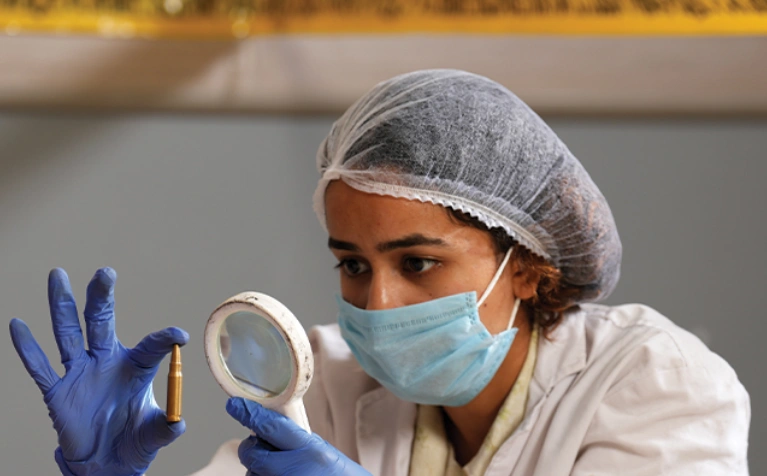
The B.Sc. (Honors with Research) in Forensic Science at GD Goenka University is a rigorous, four-year multidisciplinary undergraduate program designed to cultivate world-class forensic scientists capable of addressing complex challenges in criminal justice, national security, and scientific investigation.
which emphasize interdisciplinary scientific rigor, ethical application, and courtroom-ready skills aligned with NEP 2020, the program integrates foundational sciences like Biology, Chemistry, Physics with advanced forensic applications, legal frameworks, and cutting-edge research methodologies. Rooted in evidence-based education standards inspired by Directorate of Forensic Science Services i.e., DFSS guidelines, it fosters critical thinking, hands-on laboratory mastery, crime scene reconstruction, and ethical expertise.
The Honors with Research pathway culminates in a substantial independent dissertation, preparing graduates for immediate professional roles or seamless progression to top-tier master's/doctoral programs worldwide. With access to state-of-the-art labs, industry MoUs which focus on emerging areas like digital forensics and DNA technologies, the program ensures global acceptability through alignment with international benchmarks for quality, research output, and professional practice.
Program Specialisation
Program Highlights
Elite Interdisciplinary Curriculum: Combines core sciences with specialized modules in crime scene management, forensic biology/chemistry/physics, toxicology, ballistics, questioned documents, fingerprints, cyber forensics, and forensic psychology. Which mirroring as elite institution's practical application and analytical depth.
Research Excellence: Dedicated 4th-year research dissertation with faculty mentorship, promoting original contributions akin to high quality standards and research-oriented integrated models.
Global and Ethical Orientation: Emphasis on international legal systems, quality assurance (ISO-aligned), ethics, and expert witness skills for seamless global mobility.
Career-Ready Outcomes: Strong placement pathways in premier labs, law enforcement, and research; high employability through practical skills and networking.
Holistic Development: Skill enhancement in academic writing and communication, data analysis, and innovation, with options for international collaborations and certifications.
Programme Specific Outcome (PSO)
PSO 01
Advanced knowledge in Forensic Science: To develop the advanced understanding of the fundamentals of Chemistry, Physics, Biology applied in forensics investigations and instrumental techniques in the analysis of forensic samples.
PSO 02
Problem solving and Critical Thinking: Capability to extrapolate from what one has learned and apply their competencies to solve different kinds of non-familiar problems in examination of trace evidences, Crime scene investigation and their reporting.
PSO 03
Professional Development: Graduates would expertise in successful careers based on their understanding of formal and practical skills of Forensic investigation in various sub discipline of Forensic Science like Anthropology, Questioned Documents, Fingerprint analysis, Forensic Serology, DNA fingerprinting, Cyber forensics, forensic ballistics, and the examination of physical evidences and the identification of suspect
Programme Educational Objectives (PEO)
Scientific Foundation and Application
Graduates will apply core principles of biology, chemistry, physics, and mathematics to forensic investigations, demonstrating competence in evidence analysis and problem-solving in legal contexts.
Professional Practice and Ethics
Prepare ethical, skilled professionals ready for roles in forensic laboratories, law enforcement, or related fields, with strong communication skills for expert testimony and interdisciplinary collaboration.
Research and Innovation
Equip students with research capabilities via the Honors dissertation to contribute to advancements in forensic science, supporting lifelong learning and adaptation to emerging technologies like digital forensics and molecular techniques.
Global and Societal Impact
Foster graduates who promote justice, uphold human rights in forensic applications, and engage in international best practices for crime prevention and resolution.
Programme Outcomes (PO)
Capable of demonstrating comprehensive knowledge and understanding of one or more disciplines that form a part of an undergraduate programme of study. like forensic science principles integrated with natural sciences.

Ability to express thoughts and ideas effectively in writing and orally communicate with others using appropriate media confidently share one’s views and express herself/himself. Effectively document findings, prepare reports, and present evidence in simulated or real legal settings
Capability to apply analytic thought to a body of knowledge, analyze and evaluate evidence, arguments, claims, beliefs on the basis of empirical evidence identify relevant assumptions or implications; formulate coherent arguments critically evaluate practices, policies and theories by following scientific approach to knowledge development.
Capability to extrapolate from what one has learned and apply their competencies to solve different kinds of non-familiar problems, rather than replicate curriculum content knowledge and apply one’s learning to real life situations.
Ability to evaluate the reliability and relevance of evidence; identify logical flaws and holes in the arguments of others; analyze and synthesize data from a variety of sources; draw valid conclusions and support them with evidence and examples, and addressing opposing viewpoints.
A sense of inquiry and capability for asking relevant/ appropriate questions, problematizing, synthesizing and articulating; Ability to recognize cause-and effect relationships, define problems, formulate hypotheses, test hypotheses, analyze, interpret and draw conclusions from data, establish hypotheses, predict cause- and-effect relationships; ability to plan, execute and report the results of an experiment or investigation.
Critical sensibility to lived experiences, with self-awareness and reflexivity of both self and society.
To embrace moral/ethical values in conducting one’s life, formulate a position/argument about an ethical issue from multiple perspectives, and use ethical practices in all work. Capable of demonstrating the ability to identify ethical issues related to one’s work, avoid unethical behavior such as fabrication, falsification or misrepresentation of data or committing plagiarism, not adhering to intellectual property rights; appreciating environmental and sustainability issues; and adopting objective, unbiased and truthful actions in all aspects of work.
Work effectively in multidisciplinary teams, including with law enforcement and legal professionals.
Ability to analyze, interpret and draw conclusions from quantitative/qualitative data and critically evaluate ideas, evidence and experiences from an open-minded and reasoned perspective.
Capability to use ICT in a variety of learning situations, demonstrate ability to access, evaluate, and use a variety of relevant information sources; and use appropriate software for analysis of data.
Ability to work independently, identify appropriate resources required for a project, and manage a project through to completion.
Possess knowledge of the values and beliefs of multiple cultures and a global perspective; and capability to effectively engage in a multicultural society and interact respectfully with diverse groups.
Capability for mapping out the tasks of a team or an organization, and setting direction, formulating an inspiring vision, building a team who can help achieve the vision and apply forensic knowledge responsibly for justice, public safety, and community impact
Engage in continuous professional development and adapt to technological/scientific advancements.
Curriculum Details
| Course Code | Course Title | L | T | P | Credits |
|---|---|---|---|---|---|
| FSC1102/FSC1102L | Forensic Science & Criminology | 3 | 0 | 2 | 4 |
| CHE1209/CHE1209L | Chemistry for Life Sciences | 3 | 0 | 2 | 4 |
| PHY1206/PHY1206L | Physics in Forensic Applications | 3 | 0 | 2 | 4 |
| FSC2001 | Criminal Law & Economic Offences | 3 | 0 | 2 | 4 |
| COM1531 | Contemporary English | 0 | 0 | 4 | 2 |
| VAC001 | Design Thinking | 2 | 0 | 0 | 2 |
| Total Credits | 20 | ||||
| Course Code | Course Title | L | T | P | Credits |
|---|---|---|---|---|---|
| FSC1103/FSC1103L | Crime Scene Investigation and Physical Evidences | 3 | 0 | 2 | 4 |
| CHE1210/CHE1210L | Chemical Dynamics & Materials | 3 | 0 | 2 | 4 |
| PHY1207/PHY1207L | Quantum to Nuclear Physics in Forensic Science | 2 | 0 | 1 | 3 |
| FSC0005 | Forensic Methods of Victim Identification | 2 | 0 | 0 | 2 |
| COM1542 | Professional Skills & Ability Enhancement | 0 | 0 | 4 | 2 |
| CSE1711 | Artificial Intelligence and its real world applications | 1 | 0 | 2 | 2 |
| LAW1013 | Fundamentals of Indian Constitutional Law | 3 | 0 | 0 | 3 |
| Total Credits | 20 | ||||
| Course Code | Course Title | L | T | P | Credits |
|---|---|---|---|---|---|
| FSC1108/FSC1108L | Impression Evidence Analysis in Forensic Science | 3 | 0 | 2 | 4 |
| FSC2103/FSC2103L | Fingerprint Analysis | 3 | 0 | 2 | 4 |
| FSC1110/FSC1110L | Essential of Cell Biology, Physiology & Genetics | 3 | 0 | 2 | 4 |
| COM2531 | Academic Writing and Scholarly Communication/Problem Solving with Python | 1 | 0 | 2 | 2 |
| IDP2501/ IDP2502 | Business Model/Research Model | 0 | 0 | 6 | 3 |
| HUM1791 | Indian Traditional Knowledge | 3 | 0 | 0 | 3 |
| Total Credits | 20 | ||||
| Course Code | Course Title | L | T | P | Credits |
|---|---|---|---|---|---|
| FSC1111/FSC1111L | Biological Analysis and Laboratory Techniques | 3 | 0 | 2 | 4 |
| FSC2104/FCS2104L | Forensic Document Examination | 3 | 0 | 2 | 4 |
| FSC2111/FSC2111L | Forensic Instrumentation & Investigation Methods | 3 | 0 | 0 | 3 |
| FSC0007 | Computer Forensics | 4 | 0 | 0 | 4 |
| IDP2503/IDP2504 | Business Model/Research Model | 0 | 0 | 6 | 3 |
| VAC003 | Environmental Studies | 2 | 0 | 0 | 2 |
| Total Credits | 20 | ||||
| Course Code | Course Title | L | T | P | Credits |
|---|---|---|---|---|---|
| SCI3502 | Summer Internship | 0 | 0 | 8 | 4 |
| FSC2102/FSC2102L | Forensic Analysis of Chemical Evidence | 3 | 0 | 2 | 4 |
| FSC3101/FSC3101L | Biological Evidence in Forensic Science | 3 | 0 | 2 | 4 |
| FSC3102 | Forensic Analytical Techniques | 3 | 0 | 2 | 4 |
| FSC2109 | Wildlife Forensics & Crime Investigation | 4 | 0 | 0 | 4 |
| Total Credits | 20 | ||||
| Course Code | Course Title | L | T | P | Credits |
|---|---|---|---|---|---|
| FSC3107/FSC3107L | Forensic Toxicology & Pharmacology | 3 | 0 | 2 | 4 |
| FSC3108/FSC3108L | Cyber Crime & Digital Forensics | 3 | 0 | 2 | 4 |
| FSC3109/FSC3109L | Immunology and Forensic Serology | 3 | 0 | 2 | 4 |
| FSC3110/FSC3110L | Fire and Arson Investigation | 3 | 0 | 2 | 4 |
| FSC2108 | Forensic Entomology | 3 | 0 | 2 | 4 |
| Total Credits | 20 | ||||
| Course Code | Course Title | L | T | P | Credits |
|---|---|---|---|---|---|
| FSC4105/FSC4105L | Forensic Ballistics | 3 | 0 | 2 | 4 |
| FSC4106/FSC4106L | Forensic Genetics & Anthropology | 3 | 0 | 2 | 4 |
| FSC4107/FSC4107L | Criminology & Penology | 2 | 0 | 2 | 4 |
| FSC4813 | Criminal Psychology | 2 | 0 | 0 | 2 |
| FSC4814 | Crime Scene Mapping & Spatial Analysis | 4 | 0 | 0 | 2 |
| FSC4812 | Forensic Blood Stain Pattern | - | 0 | 0 | 4 |
| Total Credits | 20 | ||||
| Course Code | Course Title | L | T | P | Credits |
|---|---|---|---|---|---|
| SCI4503 | Research Dissertation | 4 | 0 | 24 | 12 |
| MOOC | 4 | 0 | 0 | 4 | |
| MOOC | 4 | 0 | 0 | 4 | |
| Total Credits | 20 | ||||
| OR-SEMESTER -VIII | |||||
| FSC4815 | Forensic Nanotechnology & Analytical Techniques | 3 | 0 | 0 | 3 |
| FSC4816 | Forensic Biotechnology & Microbiology | 3 | 0 | 0 | 3 |
| FSC4506 | Applied Forensic Lab | 0 | 0 | 2 | 1 |
| FSC4507 | Advanced Forensic Techniques Lab | 0 | 0 | 2 | 1 |
| FSC4817 | Biostatistics & Research Methodology | 2 | 0 | 0 | 2 |
| FSC4818 | Forensic Report Writing | 1 | 0 | 0 | 1 |
| SEM4501 | Seminar | 1 | 0 | 0 | 1 |
| MOOC | 4 | 0 | 0 | 4 | |
| MOOC | 4 | 0 | 0 | 4 | |
| Total Credits | 20 | ||||
Career Path
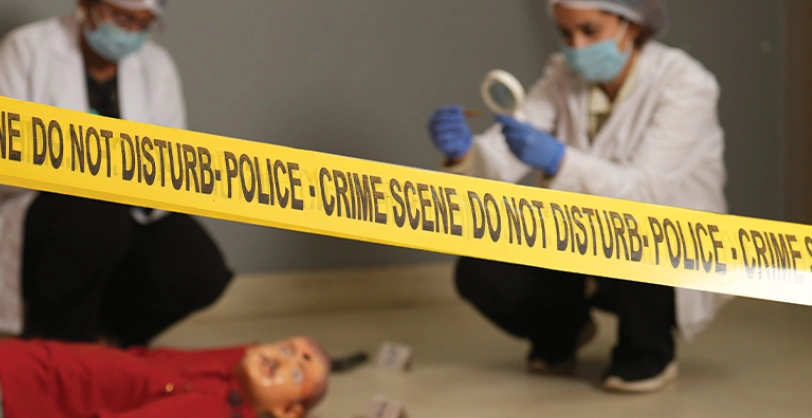
Forensic science graduates have strong career prospects in law enforcement, government labs, private sectors, research, and specialized fields. like Central/State/Regional Forensic Science Laboratories, Police headquarters, Hospitals & Medical Colleges, Law Firms, Banks, Private labs higher education/research, or roles in investigation, evidence analysis, and expert testimony.
Fee Structure
Yearly
| 1st Year | 2nd Year | 3rd Year | 4th Year |
|---|---|---|---|
| ₹1,55,000 | ₹1,25,000 | ₹1,25,000 | ₹1,25,000 |
Semester Wise
| 1st Sem | 2nd Sem | 3rd Sem | 4th Sem | 5th Sem | 6th Sem | 7th Sem | 8th Sem |
|---|---|---|---|---|---|---|---|
| ₹92,500 | ₹62,500 | ₹62,500 | ₹62,500 | ₹62,500 | ₹62,500 | ₹62,500 | ₹62,500 |
Admission Process
Admission Process
Complete the online application. Appear for GATA entrance test and personal interview. Get shortlisted and receive offer letter.
Admission Requirement
As per eligibility (10+2 Science with 50% + GATA + Interview). Marksheet and certificates of 10+2, migration and transfer certificate, Character certificate, Medical Fitness certificate,
Eligibility
10+2 from CBSE or equivalent with science subjects (Physics, Chemistry, Biology/Mathematics – PCB/PCM) and minimum 50% aggregate. Candidates must appear for GATA (Goenka Aptitude Test for Admission) + Personal Interview.


 About Us