
Post Graduate Diploma in Clinical Embryology*
Duration1 Year
Course Fee2.90 Lakhs

The Post Graduate Diploma in Clinical Embryology is an intensive vocational program tailored for medical technicians, lab professionals, and graduates seeking rapid entry into the fertility field.
The curriculum focuses heavily on hands-on technical dexterity, strict standard operating procedure (SOP) adherence, and process documentation. Students master essential andrology workflows, culture media preparation, and error-free sample double-witnessing tracking systems. Graduates are uniquely equipped to maintain rigorous laboratory quality controls, immediately preparing them for critical clinical roles. This specialized training serves as a direct pipeline to career trajectories including Junior Embryologist, Andrologist, Quality Control Technician, or Cryobanking Associate.
Program Specialisation
Programme Highlights
- Industry-oriented curriculum aligned with current Assisted Reproductive Technology (ART) practices.
- Exposure to modern IVF laboratory protocols and quality assurance standards.
- Training under experienced faculty and reproductive medicine professionals.
- State-of-the-art laboratory facilities with advanced equipment for practical learning.
- Clinical exposure through internships/observerships at IVF and fertility centres.
- Focus on ethical, legal, and regulatory aspects of assisted reproductive technologies.
- Skill development in laboratory safety, quality control, documentation, and patient confidentiality.
- Research-oriented learning with opportunities to participate in reproductive biology and fertility research.
- Strong career prospects in IVF clinics, hospitals, cryobanks, research institutes, and biotechnology companies.
- Hands-on laboratory training in embryology, andrology, gamete handling, embryo culture, and cryopreservation techniques.
Programme Specific Outcome (PSO)
PSO 01
Perform routine and automated semen analysis, preparation, and sperm banking procedures independently.
PSO 02
Master the preparation, equilibration, and strict handling of specialized culture media and oil overlays.
PSO 03
Maintain precise physical, electronic, and cryogenic documentation of patient samples with zero-mixup tolerance.
PSO 04
Execute rapid vitrification and thawing protocols for human gametes and embryos with high post-thaw survival rates.
PSO 05
Calibrate, operate, and troubleshoot high-precision IVF laboratory instruments, including micromanipulators and benchtop tri-gas incubators.
PSO 06
Enforce stringent quality control measures, monitoring room temperature, humidity, volatile organic compounds, and gas concentration levels daily.
PSO 07
Implement strict double-witnessing workflows and chain-of-custody protocols during every phase of gamete and embryo handling.
PSO 08
Identify, grade, and pick human oocytes during ultrasound-guided follicular aspirations under stereomicroscopic guidance.
PSO 09
Demonstrate baseline technical proficiency in performing intracytoplasmic sperm injection and embryo biopsy techniques safely.
PSO 10
Conduct all laboratory procedures in strict compliance with the ART Regulation Act and national bioethical guidelines.
Programme Educational Objectives (PEO)
PEO 01
Provide immediate vocational skills to secure employment as junior embryologists, lab technicians, or technical consultants.
PEO 02
Train technicians to deliver rapid, error-free operational support in high-throughput IVF chains.
PEO 03
Ensure absolute compliance with standard operating protocols (SOPs) during routine reproductive workflows.
PEO 04
Cultivate a deep understanding of laboratory biosafety, sterile room ergonomics, and contamination control protocols.
PEO 05
Prepare professionals to handle critical equipment troubleshooting, calibration, and gas phase monitoring independently.
PEO 06
Instill strong ethical foundations regarding patient identity validation, data documentation, and legal confidentiality.
PEO 07
Develop effective communication skills for seamless cross-functional coordination between clinicians and embryology teams.
PEO 08
Foster a mindset of continuous learning to adapt to advancing reproductive technologies and digital laboratory systems.
PEO 09
Equip students with the technical precision required for high-yield sperm preparation, analysis, and processing.
PEO 10
Train graduates to maintain strict quality management systems (QMS) aligned with national and international health guidelines.
Programme Outcomes (PO)
Demonstrate high dexterity in operating laminar airflows, centrifuges, and basic stereomicroscopes.

Follow strict chain-of-custody protocols for double-witnessing during gamete handling.
Perform daily maintenance, temperature monitoring, and gas cylinder replacements efficiently.
Respond quickly to critical incubator alarms, power failures, or liquid nitrogen depletions.
Coordinate seamlessly with nursing staff, operating theater teams, and laboratory managers.
Execute routine semen analysis, morphology screening, and advanced sperm preparation techniques accurately.
Perform rapid freezing and thawing protocols for gametes and embryos with high post-thaw survival rates.
Monitor air quality parameters, volatile organic compounds (VOCs), and sterile conditions inside the IVF laboratory.
Adhere strictly to regional statutory mandates, patient confidentiality guidelines, and national ART regulatory laws.
Maintain comprehensive, error-free electronic medical records, patient consent forms, and laboratory logs.
Curriculum Details
| Paper Code | Course Title | L | T | P | Credits | TI | TE | PI | PE | Total |
|---|---|---|---|---|---|---|---|---|---|---|
| PGD101T | Reproductive Biology and Endocrinology | 3 | 1 | 0 | 4 | 30 | 70 | - | - | 100 |
| PGD102T | Andrology and Clinical Embryology | 3 | 1 | 0 | 4 | 30 | 70 | - | - | 100 |
| PGD103T | Human Gametes and Embryo culture systems | 3 | 1 | 0 | 4 | 30 | 70 | - | - | 100 |
| PGD104P | Practical I: Andrology + Oocyte /Embryo Handling | 0 | 0 | 6 | 3 | - | - | 25 | 50 | 75 |
| PGD105P | Practical II: Cryobiology and Micromanipulation | 0 | 0 | 6 | 3 | - | - | 25 | 50 | 75 |
| Totals | 9 | 3 | 12 | 18 | 450 |
| Paper Code | Course Title | L | T | P | Credits | TI | TE | PI | PE | Total |
|---|---|---|---|---|---|---|---|---|---|---|
| PGD206T | Research Methodology and Technical Writing | 1 | 1 | 0 | 2 | 15 | 35 | - | - | 50 |
| PGD207PR | Dissertation + Viva | 0 | 0 | 0 | 20 | - | - | - | 500 | 500 |
| Total | 22 | 550 | ||||||||
Assessment criteria for Dissertation/Research Project:
- Final dissertation/Project Work -350 Marks
- Viva Voce / defenses – 150 Marks
Career Path
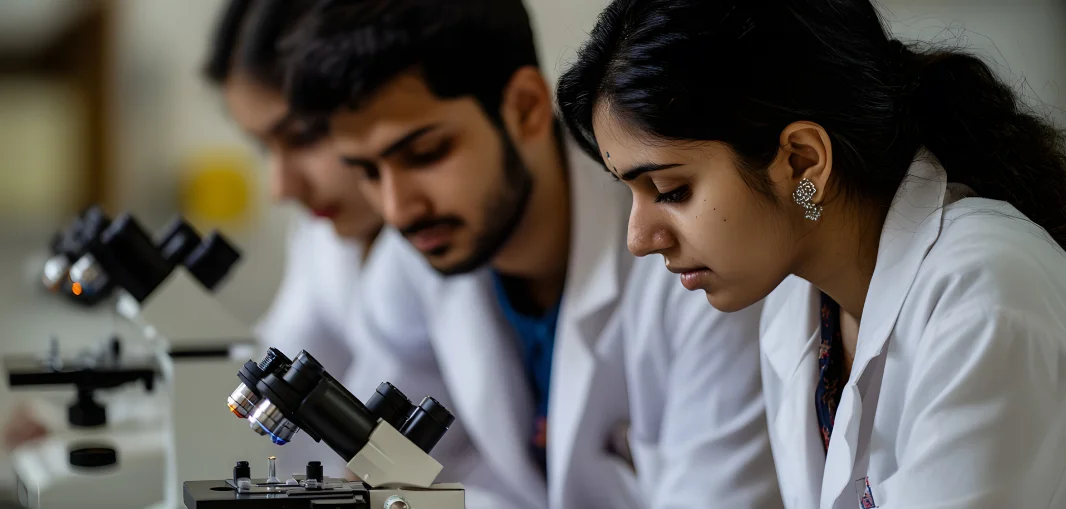
Graduates of the PG Diploma in Clinical Embryology can pursue careers in the following roles and sectors:
- Clinical Embryologist – Perform IVF laboratory procedures, gamete handling, embryo culture, cryopreservation, and assisted reproductive technology (ART) techniques.
- Junior Embryologist – Assist senior embryologists in embryo culture, laboratory operations, quality assurance, and monitoring embryo development.
- Andrologist – Conduct male fertility assessments, semen analysis, sperm preparation, and processing for ART procedures.
- ART Laboratory Technologist – Manage laboratory equipment, maintain quality control, and ensure sterile laboratory environments.
- Fertility Counsellor – Guide and educate patients throughout fertility evaluation and treatment procedures.
- Research Associate – Contribute to research in reproductive biology, embryology, and assisted reproductive technologies.
- IVF and Fertility Clinics – Work in private, corporate, and standalone fertility centres.
- Hospitals – Join reproductive medicine and infertility departments in multispecialty hospitals.
- Cryobanks and Cryopreservation Centres – Manage the storage and preservation of sperm, oocytes, embryos, and reproductive tissues.
- Research Institutes – Participate in biomedical and clinical research related to reproductive health and fertility.
- Academic Institutions – Serve as laboratory instructors, teaching assistants, or research staff.
- Biotechnology and Pharmaceutical Companies – Support the development of fertility diagnostics, laboratory technologies, and ART products.
Fee Structure
Yearly
| 1st Year |
|---|
| ₹2,90,000 |
Fee Semester Wise
| 1st Sem | 2nd Sem |
|---|---|
| ₹1,65,000 | ₹1,25,000 |
Postgraduate Diploma in Clinical Embryology
Bachelor's degree in Life Sciences, Biotechnology, Biomedical Sciences, Allied Health Sciences, Medicine, Nursing, Pharmacy, Physiotherapy, or related disciplines from a recognized university.
Frequently Asked Questions
The program is an intensive, fast-track course that is completed within 1 year across two academic semesters.
Applicants must possess a Bachelor's degree in Life Sciences, Biotechnology, Zoology, Microbiology, Medicine (MBBS/BAMS/BHMS), or Pharmacy from a recognized university.
Selection is primarily based on undergraduate academic merit, followed by an internal aptitude screening or a personal interview to assess foundational knowledge.
The diploma is a shorter program (1 year vs. 2 years) designed to fast-track clinical skills and laboratory readiness rather than extensive academic research.
Yes, the curriculum places heavy emphasis on practical training, allowing students to master semen analysis, sperm preparation, and embryo grading.
Major subjects include Andrology, Clinical Embryology, Media and Culture Systems, Cryobiology (freezing techniques), and Ethics in Assisted Reproductive Technology (ART).
The program incorporates mandatory clinical training or attachments at operational IVF centers to give students exposure to real patient-case workflows.
Graduates typically start their careers as a junior clinical embryologist, dedicated andrologist, or fertility laboratory technician.
Primary employment sectors include private IVF clinics, hospital reproductive medicine departments, cryobanks, and reproductive research facilities.
Yes, students receive job placement assistance and interview preparation through the university's dedicated Corporate Resource Centre and industry partners.


 About Us