
M.Sc. in Clinical Embryology
Duration2 Years
Course Fee4.80 Lakhs
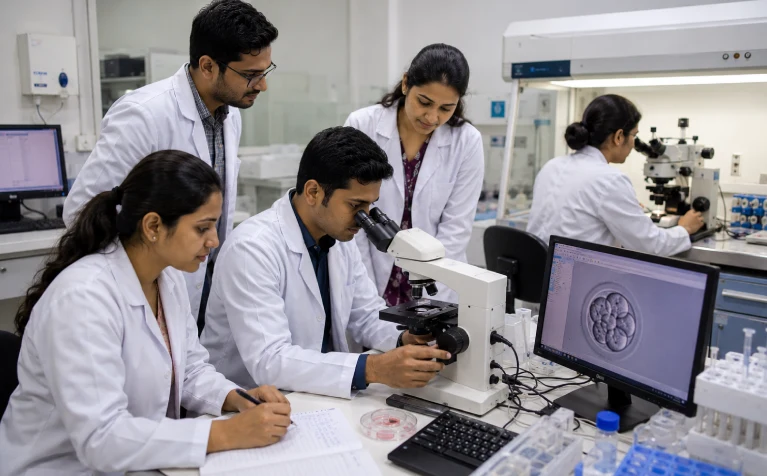
The M.Sc. in Clinical Embryology is a specialized postgraduate program designed to provide comprehensive knowledge and practical skills in reproductive sciences, clinical embryology, Assisted Reproductive Technology (ART), and fertility research.
The program is suited for graduates from Life Sciences, Biotechnology, Medical, and related disciplines, with a focus on advanced laboratory techniques such as embryo culture, micromanipulation, Intracytoplasmic Sperm Injection (ICSI), cryopreservation, and blastocyst vitrification. Through hands-on training and research exposure, the program prepares graduates for professional careers in IVF and fertility clinics, ART laboratories, cryobanks, research institutions, biotechnology industries, and academia.
Program Specialisation
Highlighs
- Advanced ART specialization: Focuses heavily on the science and mechanics behind Assisted Reproductive Technologies like IVF, ICSI, and IMSI.
- Postgraduate track: Designed as a two-year master's program tailored specifically for Life Science, MBBS, BDS, or Nursing graduates.
- NEET PG exemption: Provides a direct pathway to a high-demand clinical medical field without clearing NEET PG exams.
- Hands-on micromanipulation: Delivers intensive training in delicate tasks like gamete handling, fertilization assessment, and embryo grading.
- Cryopreservation mastery: Teaches critical skills in vitrification, long-term storage, and safe thawing of eggs, sperm, and embryonic tissues.
- Andrology laboratory training: Covers advanced male fertility assessments, sperm processing, and diagnostic semen analysis protocols.
- Immersive clinical rotations: Features mandatory internships and hospital postings inside active, real-world fertility clinics.
- Quality control management: Trains students in maintaining sterile environments, calibration, and troubleshooting IVF lab equipment.
- Bioethics and regulations: Focuses on strict medical ethics, international guidelines, and national ART regulatory laws.
- Research dissertation: Requires completing an independent research project or thesis in reproductive biology during the final year.
Programme Specific Outcome (PSO)
PSO 01
Gamete Manipulation: Students will master the handling, preparation, and assessment of human gametes. They will expertly evaluate sperm parameters and determine oocyte maturity for clinical procedures.
PSO 02
Advanced Micromanipulation: Students will demonstrate proficiency in high-precision micromanipulation techniques. They will independently perform Intracytoplasmic Sperm Injection (ICSI) and laser-assisted embryo hatching.
PSO 03
Cryopreservation Expertise: Students will execute advanced vitrification and thawing protocols for reproductive tissues. They will successfully preserve oocytes, sperm, and blastocysts with high post-thaw survival rates.
PSO 04
Embryo Culture and Grading: Students will manage specialized incubator systems and specific culture media. They will continuously monitor and grade embryo development from fertilization to the blastocyst stage.
PSO 05
Preimplantation Genetics: Students will understand genetic screening and biopsy techniques for preimplantation embryos. They will safely perform trophectoderm biopsies and prepare samples for genetic testing.
PSO 06
Lab Design and Maintenance: Students will design functional layouts for cleanroom IVF laboratories. They will maintain strict control over air quality, volatile organic compounds (VOCs), and temperature parameters.
PSO 07
Quality Control Implementation: Students will execute daily quality assurance and quality control checks in the lab. They will calibrate delicate equipment, manage inventory, and log key performance indicators.
PSO 08
ART Regulations and Ethics: Students will apply national and international regulatory laws governing assisted reproduction. They will practice strict ethical guidelines regarding gamete donation, surrogacy, and embryo disposal.
PSO 09
Clinical Data Management: Students will manage electronic medical records and maintain flawless chain-of-custody protocols. They will utilize specialized IVF software to eliminate sample mismatching and errors.
PSO 10
Troubleshooting and Analytics: Students will analyze sudden drops in fertilization or pregnancy success rates. They will systematically troubleshoot equipment failures and culture system issues to restore optimal outcomes
Programme Educational Objectives (PEO)
PEO 01
Clinical Competence: Graduates will master advanced Assisted Reproductive Technology (ART) procedures. They will perform intracytoplasmic sperm injection, embryo culture, and cryopreservation safely.
PEO 02
Laboratory Leadership: Graduates will manage and direct high-standard human IVF laboratories globally. They will oversee standard operating procedures, staff workflows, and regulatory compliance.
PEO 03
Research Innovation: Graduates will design and conduct impactful scientific research in reproductive medicine. They will publish findings to advance knowledge in fertility and embryological sciences.
PEO 04
Ethical Practice: Graduates will navigate complex bioethical dilemmas and medical law frameworks. They will protect patient confidentiality, genetic data privacy, and reproductive rights.
PEO 05
Quality Assurance: Graduates will implement rigorous quality control protocols across all lab operations. They will maintain optimal equipment calibration and strict environmental conditions for embryos.
PEO 06
Lifelong Learning: Graduates will pursue continuous professional development and advanced certifications. They will quickly adopt emerging technologies like artificial intelligence and automation in ART.
PEO 07
Interdisciplinary Collaboration: Graduates will communicate effectively within multi-disciplinary healthcare teams. They will bridge communication gaps between clinicians, genetic counselors, and patients.
PEO 08
Critical Problem-Solving: Graduates will troubleshoot complex cellular manipulation and fertilization issues swiftly. They will apply data-driven decisions to optimize success rates in challenging cases.
PEO 09
Academic Contribution: Graduates will serve as educators and mentors in academic and clinical settings. They will train the next generation of embryologists using evidence-based teaching methods.
PEO 10
Global Professionalism: Graduates will uphold the highest standards of integrity, empathy, and care. They will practice medicine with cultural competence to serve diverse patient populations globally.
Programme Outcomes (PO)
Apply advanced concepts of human reproductive anatomy, embryology, and genetics to clinical practice. Understand the biological mechanisms underlying fertility, cell development, and reproductive disorders.

Demonstrate hands-on proficiency in executing advanced assisted reproductive technology (ART) lab procedures. Perform precise gamete handling, fertilization checks, embryo culture, and cryopreservation protocols.
Identify, analyze, and resolve critical technical issues within the clinical embryology laboratory environment. Troubleshoot suboptimal fertilization rates, culture media degradation, and equipment malfunctions systematically.
Design optimized laboratory workflows and clinical protocols to maximize embryo development and viability. Develop tailored strategies for handling complex patient cases presenting severe infertility factors.
Operate high-precision micromanipulators, laser systems, advanced incubators, and specialized IVF software effectively. Adapt seamlessly to emerging automation, digital imaging, and artificial intelligence tools in embryology.
Commit to strict ethical principles, patient data confidentiality, and medical law frameworks globally. Adhere to national and international regulatory guidelines governing assisted reproduction and gene editing.
Evaluate and manage the unique environmental factors impacting cleanroom IVF laboratory performance. Maintain strict biosafety standards, chemical hygiene, and zero-contamination protocols for human tissue handling.
Communicate complex medical and scientific data clearly to clinicians, genetic counselors, and patients. Deliver sensitive fertility updates with high emotional intelligence, empathy, and professional clarity.
Function effectively as an independent embryologist and as a collaborative member of multidisciplinary healthcare teams. Coordinate seamlessly with nurses, urologists, and gynecologists to ensure optimal patient care cycles.
Conduct structured scientific investigations, draft research protocols, and analyze clinical data sets objectively. Contribute new findings to reproductive medicine through peer-reviewed publications and conference presentations.
Recognize the need for continuous professional education in a rapidly advancing technological field. Pursue advanced certifications and training workshops to keep clinical skills aligned with global standards.
Curriculum Details
| Paper Code | Course Title | L | T | P | Credits | TI | TE | PI | PE | Total |
|---|---|---|---|---|---|---|---|---|---|---|
| MCE101T | Infertility and Reproductive Disorders: Overview and Management | 3 | 1 | 0 | 4 | 30 | 70 | - | - | 100 |
| MCE102T | Basic Andrology and Laboratory Techniques | 3 | 1 | 0 | 4 | 30 | 70 | -- | 100 | |
| MCE103T | Reproductive Biology and Anatomy | 3 | 1 | 0 | 4 | 30 | 70 | 100 | ||
| MCE104T | Cell and Molecular Biology | 2 | 1 | 0 | 3 | 25 | 50 | - | - | 75 |
| MCE105P | Hands on Demonstration: Semen Analysis, Preparation and Function Tests | 0 | 0 | 6 | 3 | --- | 25 | 50 | 75 | |
| MCE106P | Hands on Demonstration: Andrology Techniques | 0 | 0 | 4 | 2 | --- | 15 | 35 | 50 | |
| MCE107S | Case Study/ Presentation | 0 | 0 | 4 | 2 | 15 | 35 | 50 | ||
| Total | 11 | 4 | 14 | 22 | 550 | |||||
| Paper Code | Course Title | L | T | P | Credits | TI | TE | PI | PE | Total |
|---|---|---|---|---|---|---|---|---|---|---|
| MCE201T | Human Physiology and Endocrinology | 3 | 1 | 0 | 4 | 30 | 70 | - | - | 100 |
| MCE202T | Assisted Reproduction and Basic Embryology | 3 | 1 | 0 | 4 | 30 | 70 | - | - | 100 |
| MCE203T | Reproductive Immunology Ethics and Legal Framework | 3 | 1 | 0 | 4 | 30 | 70 | - | - | 100 |
| MCE204T | Biochemistry and Biophysics in ART | 2 | 1 | 0 | 3 | 25 | 50 | — | 75 | |
| MCE205P | Demonstration: Media Handling and Embryo Culture | 0 | 0 | 6 | 3 | - | - | 25 | 50 | 75 |
| MCE206P | Demonstration: Advanced Embryology Techniques | 0 | 0 | 4 | 2 | - | - | 15 | 85 | 50 |
| MCE207S | Case Study/ Presentation | 0 | 0 | 4 | 2 | - | - | 15 | 35 | 50 |
| Total | 11 | 4 | 14 | 22 | 550 | |||||
Internship or Field Training or Project of 4-6 weeks during summer vacation
| Paper Code | Course Title | L | T | P | Credits |
|---|---|---|---|---|---|
| MCE01PR | Internship/Clinical Training | — | — | — | 4 Credits |
| Paper Code | Course Title | L | T | P | Credits | TI | TE | PI | PE | Total |
|---|---|---|---|---|---|---|---|---|---|---|
| MCE301T | Cryobiology And ART | 3 | 1 | 0 | 4 | 30 | 70 | - | - | 100 |
| MCE302T | Micromanipulation and Preimplantation Genetics | 3 | 1 | 0 | 4 | 30 | 70 | - | - | 100 |
| MCE303T | Advanced Clinical Embryology, Environmental Biology and TQM in ART | 3 | 1 | 0 | 4 | 30 | 70 | - | - | 100 |
| MCE304T | Biostatistics and Bioinformatics | 2 | 1 | 0 | 3 | 25 | 50 | - | - | 75 |
| MCE305P | Hands on Demonstration: Micromanipulation Techniques | 0 | 0 | 6 | 3 | - | - | 25 | 50 | 75 |
| MCE306P | Hands on Demonstration: Cryopreservation Techniques | 0 | 0 | 4 | 2 | - | - | 15 | 35 | 50 |
| MCE307P | AI in Healthcare | 0 | 0 | 4 | 2 | - | - | 15 | 35 | 50 |
| MCE308S | Seminar | 0 | 0 | 4 | 2 | - | - | 15 | 35 | 50 |
| Total | 13 | 4 | 14 | 24 | 600 | |||||
Assessment Criteria for Dissertation/Project Work:
- Final Dissertation/Project Work – 350 Marks
- Viva Voce/ Defenses – 150 Marks
| Paper Code | Course Title | L | T | P | Credits | TI | TE | PI | PE | Total |
|---|---|---|---|---|---|---|---|---|---|---|
| MCE401T | Research and Technical Writing | 2 | 0 | 0 | 2 | 15 | 35 | - | - | 50 |
| MCE402T | Dissertation/Project Work | - | - | 40 | 20 | - | - | - | 500 | 500 |
| Total | 2 | 0 | 40 | 22 | - | - | 550 | |||
Fee Structure
Yearly
| 1st Year | 2nd Year |
|---|---|
| ₹2,60,000 | ₹2,20,000 |
Fee Semester Wise
| 1st Sem | 2nd Sem | 3rd Sem | 4th Sem |
|---|---|---|---|
| ₹1,50,000 | ₹1,10,000 | ₹1,10,000 | ₹1,10,000 |
M.Sc. in Clinical Embryology
Bachelor's degree in Life Sciences, Biotechnology, Biomedical Sciences, Allied Health Sciences, Medicine, Nursing, Pharmacy, Physiotherapy, or related disciplines from a recognized university.
Frequently Asked Questions
It is a specialized two-year postgraduate program that trains students in reproductive biology, andrology, and the laboratory technologies used in assisted reproduction.
Candidates must hold a Bachelor's degree in Life Sciences (Biotechnology, Zoology, Microbiology) or medical degrees like MBBS, BDS, B.Sc. Nursing, or BAMS.
No, qualifying for NEET is not required to secure admission into an M.Sc. in Clinical Embryology program.
Most universities require candidates to have a minimum aggregate score of 50% to 55% marks in their qualifying undergraduate degree.
Admissions are generally based on university-specific entrance exams (like GATA or CUET-PG) followed by a personal interview assessing scientific aptitude.
Yes, it offers intensive practical exposure to IVF lab workflows, including gamete handling, micromanipulation, and sperm preparation techniques.
Yes, the final semester typically features a mandatory clinical rotation or internship inside an active, real-world fertility clinic.
Graduates can start careers as junior clinical embryologists, andrologists, cryobank technicians, lab managers, or reproductive healthcare researchers.
No, clinical embryologists manage the laboratory side; an IVF clinic must be headed by a qualified medical practitioner (gynecologist/infertility specialist).
Students are trained in international bioethics and regional mandates, such as India's strict ART (Assisted Reproductive Technology) Act.


 About Us