
B. Tech. in Electronics and Communication Engineering with Specialization in Biomedical Engineering in Association with BOSCH
Duration4 Years
Course Fee8.50 Lakhs
Eligibility10+2
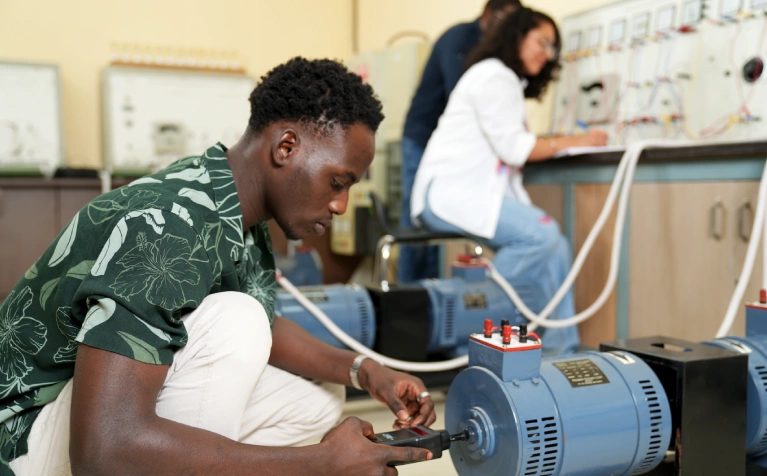
Biomedical Engineering is an interdisciplinary program that integrates engineering principles with medical and biological sciences to design and develop healthcare technologies.
The program equips students with knowledge in medical instrumentation, biomedical signal processing, imaging systems, and healthcare devices. It emphasizes practical learning, innovation, and research to address real-world medical challenges and improve patient care.
Program Specialisation
Program Highlights
- Designed in alignment with modern healthcare technology requirements and global biomedical standards.
- Focus on development and application of medical devices, diagnostic systems, and rehabilitation technologies.
- Strong foundation in biomedical instrumentation, signals & systems, and human physiology.
- Exposure to emerging fields such as medical imaging, biosensors, wearable health devices, and telemedicine.
- Interaction with healthcare professionals, industry experts, and researchers through workshops, seminars, and projects.
Industry – Relevant Exposure
Our program is designed to provide you with extensive industry-relevant exposure, including:
- Hands-on experience: Practical training on biomedical instruments, diagnostic devices, and healthcare technologies.
- Hospital & Clinical Exposure: Training opportunities in hospitals and healthcare setups to understand real-time medical equipment usage and patient care systems.
Program Specific Outcomes (PSO)
PSO 01
Design, analyze, and implement electronic and communication systems by applying core concepts of electronics, signal processing, embedded systems, and communication engineering to address real-world and emerging technological challenges.
PSO 02
Integrate modern engineering tools and interdisciplinary knowledge to create innovative, efficient, and sustainable electronics and communication solutions.
PSO 03
Develop and implement electronic systems for biomedical applications by integrating principles of instrumentation, signal processing, and healthcare technologies for diagnosis and monitoring.
Programme Outcomes (PO)
Apply the knowledge of mathematics, science, engineering fundamentals, and an engineering specialization to the solution of complex engineering problems.

Identify, formulate, review research literature, and analyze complex engineering problems reaching substantiated conclusions using first principles of mathematics, natural sciences, and engineering sciences.
Design solutions for complex engineering problems and design system components or processes that meet the specified needs with appropriate consideration for the public health and safety, and the cultural, societal, and environmental considerations.
Use research-based knowledge and research methods including design of experiments, analysis and interpretation of data, and synthesis of the information to provide valid conclusions.
Create, select, and apply appropriate techniques, resources, and modern engineering and IT tools including prediction and modeling to complex engineering activities with an understanding of the limitations.
Apply reasoning informed by the contextual knowledge to assess societal, health, safety, legal and cultural issues and the consequent responsibilities relevant to the professional engineering practice.
Understand the impact of the professional engineering solutions in societal and environmental contexts, and demonstrate the knowledge of, and need for sustainable development.
Apply ethical principles and commit to professional ethics and responsibilities and norms of the engineering practice.
Function effectively as an individual, and as a member or leader in diverse teams, and in multidisciplinary settings.
Communicate effectively on complex engineering activities with the engineering community and with society at large, such as, being able to comprehend and write effective reports and design documentation, make effective presentations, and give and receive clear instructions.
Demonstrate knowledge and understanding of the engineering and management principles and apply these to one’s own work, as a member and leader in a team, to manage projects and in multidisciplinary environments.
Recognize the need for, and have the preparation and ability to engage in independent and life-long learning in the broadest context of technological change.
Curriculum Details
| Course Code | Course Title | L | T | P | Credits |
|---|---|---|---|---|---|
| MAT1121 | Linear Algebra, Calculus and Ordinary Differential Equations | 3 | 1 | 0 | 4 |
| PHY1009/PHY1009L | Elements of Modern Physics/Elements of Modern Physics Lab | 3 | 0 | 2 | 4 |
| CSE1010/CSE1010L | Problem Solving through Programming/Problem Solving through Programming Lab | 3 | 0 | 2 | 4 |
| ELE1001/ELE1001L | Fundamentals of Electrical and Electronics Engineering/Fundamentals of Electrical and Electronics Engineering Lab | 3 | 0 | 2 | 4 |
| COM1531 | Contemporary English | 0 | 0 | 4 | 2 |
| VAC001 | Design Thinking | 2 | 0 | 0 | 2 |
| EGR1501 | Induction Program | 0 | 0 | 0 | 0 |
| Total Credits | 20 | ||||
| Course Code | Course Title | L | T | P | Credits |
|---|---|---|---|---|---|
| MAT1122 | Vector Calculus, Transforms and Partial Differential Equations | 3 | 1 | 0 | 4 |
| PHY1008/PHY1008L | Quantum Mechanics/Quantum Mechanics Lab | 3 | 0 | 2 | 4 |
| ELX1002/ELX1002L | Digital Electronics/Digital Electronics Lab | 3 | 0 | 2 | 4 |
| MEC1509 | Engineering Graphics | 0 | 0 | 4 | 2 |
| COM1542 | Professional Skills & Ability Enhancement | 0 | 0 | 4 | 2 |
| CSE1711 | Artificial Intelligence and its Real-World Applications | 2 | 0 | 0 | 2 |
| LAW1010 | Introduction to the Indian Constitution | 3 | 0 | 0 | 0 |
| VAC004 | Introduction to Indian Knowledge System | 2 | 0 | 0 | 2 |
| Total Credits | 20 | ||||
| Course Code | Course Title | L | T | P | Credits |
|---|---|---|---|---|---|
| MAT2719 | Complex Analysis, Numerical Methods and Probability Distributions | 3 | 0 | 0 | 3 |
| ELX2010/ELX2010L | Circuit Analysis and Synthesis/Circuit Analysis and Synthesis Lab | 3 | 0 | 2 | 4 |
| ELX2004/ELX2004L | Signals and Systems/Signals and Systems Lab | 3 | 0 | 2 | 4 |
| CHE1006/CHE1006L | Electrochemical Energy Systems and Advanced Materials/Electrochemical Energy Systems and Advanced Materials Lab | 2 | 0 | 2 | 3 |
| OR | |||||
| BME1011/BME1011L | Biology for Engineers/Biology for Engineers Lab | 2 | 0 | 2 | 3 |
| ELX1501 | Electronics Workshop for Engineers | 0 | 0 | 4 | 2 |
| UHV2701 | Universal Human Values | 3 | 0 | 0 | 3 |
| IDP2501/IDP2502 | Developing a Business Model/Research & Design | 0 | 1 | 4 | 3 |
| Total Credits | 22 | ||||
| Course Code | Course Title | L | T | P | Credits |
|---|---|---|---|---|---|
| ELX2009/ELX2009L | Analog and Digital Communication/Analog and Digital Communication Lab | 3 | 0 | 2 | 4 |
| ELX2105/ELX2105L | Electronic Devices/Electronic Devices Lab | 3 | 0 | 2 | 4 |
| ELX2701 | Electromagnetic Field Theory | 3 | 0 | 0 | 3 |
| ELX2012/ELX2012L | Sensors and Transducers/Sensors and Transducers Lab | 3 | 0 | 2 | 4 |
| Specialized Track-I | 3 | 0 | 2 | 4 | |
| IDP2503/IDP2504 | Translating Business Model/Data Analysis & Publication | 0 | 0 | 6 | 3 |
| ENV1705 | Environmental Studies | 0 | 1 | 4 | 0 |
| Total Credits | 22 | ||||
| Course Code | Course Title | L | T | P | Credits |
|---|---|---|---|---|---|
| ELX2002/ELX2002L | Control Systems/Control Systems Lab | 3 | 0 | 2 | 4 |
| ELX3008/ELX3008L | Microprocessor and Microcontrollers/Microprocessor and Microcontrollers Lab | 3 | 0 | 2 | 4 |
| ELX3025/ELX3025L | Integrated Circuits/Integrated Circuits Lab | 2 | 0 | 2 | 3 |
| ELX3022/ELX3022L | Discrete Signal Processing/Discrete Signal Processing Lab | 3 | 0 | 2 | 4 |
| Program Elective-I | 3 | 0 | 0 | 3 | |
| Specialized Track - II | 3 | 0 | 0 | 3 | |
| TRA2503 | Aptitude Building and Placement Readiness Program - I | 0 | 0 | 2 | 0 |
| Total Credits | 21 | ||||
| Course Code | Course Title | L | T | P | Credits |
|---|---|---|---|---|---|
| ELX3026/ELX3026L | Embedded Systems/Embedded Systems Lab | 2 | 0 | 2 | 3 |
| Specialized Track - III | 3 | 0 | 2 | 4 | |
| Program Elective-II | 3 | 0 | 0 | 3 | |
| Program Elective-III | 3 | 0 | 0 | 3 | |
| Open Elective-I | 3 | 0 | 0 | 3 | |
| Specialized Track - IV | 3 | 0 | 0 | 3 | |
| TRA2505 | Aptitude Building and Placement Readiness Program - II | 0 | 0 | 2 | 0 |
| Total Credits | 19 | ||||
| Course Code | Course Title | L | T | P | Credits |
|---|---|---|---|---|---|
| ELX4001/ELX4001L | Antenna and Wave Propagation/Antenna and Wave Propagation Lab | 3 | 0 | 2 | 4 |
| Specialized Track - V | 3 | 0 | 2 | 4 | |
| Program Elective-IV | 3 | 0 | 2 | 4 | |
| Program Elective-V | 3 | 0 | 0 | 3 | |
| Open Elective II | 3 | 0 | 0 | 3 | |
| EGR4501 | Project Phase-I | 3 | |||
| EGR4502 | Summer Internship | 2 | |||
| Total Credits | 23 | ||||
| Course Code | Course Title | L | T | P | Credits |
|---|---|---|---|---|---|
| Open Elective III | 3 | 0 | 0 | 3 | |
| EGR4503 | Project Phase-II | 10 | |||
| Semester Credits | 13 | ||||
List of Electives
*Open Electives (OE) (Elective Courses offered by Other Schools)
| Course Code | Paper Title | Credits |
|---|---|---|
| ITM2761 | Marketing in Digital World | 3 |
| ENP2763 | Entrepreneurship Development | 3 |
| CSE4911 | Business Planning and Project Management | 3 |
| CSE4912 | Geographical Information System | 3 |
Internet of Things (IoT)
| Course Code | Course Title | L | T | P | Credits |
|---|---|---|---|---|---|
| ELX2013/ELX2013L | Internet of Things and its Applications/Internet of Things and its Applications Lab | 3 | 0 | 2 | 4 |
| ELX2714 | Communication Protocols for IoT | 3 | 0 | 0 | 3 |
| ELX2014/ELX2014L | PLC, HMI and SCADA/PLC, HMI and SCADA Lab | 3 | 0 | 2 | 4 |
| ELX2715 | IoT Application and Security | 3 | 0 | 0 | 3 |
| ELX3018/ELX3018L | IoT Application Development & Prototyping/IoT Application Development & Prototyping Lab | 3 | 0 | 2 | 4 |
Biomedical Engineering (BME)
| Course Code | Course Title | L | T | P | Credits |
|---|---|---|---|---|---|
| BME2005/BME2005L | Biomedical Instrumentation/Biomedical Instrumentation Lab | 3 | 0 | 2 | 4 |
| BME2714 | Cell and Tissue Engineering | 3 | 0 | 0 | 3 |
| BME3010/BME3010L | Biomedical Signal Processing/Biomedical Signal Processing Lab | 3 | 0 | 2 | 4 |
| BME3725 | Artificial Organs and Rehabilitation Engineering | 3 | 0 | 0 | 3 |
| BME3011/BME3011L | Medical Image Processing/Medical Image Processing Lab | 3 | 0 | 2 | 4 |
VLSI
| Course Code | Course Title | L | T | P | Credits |
|---|---|---|---|---|---|
| ELX2024/ELX2024L | Low-power Devices and Circuits/Low-power Devices and Circuits Lab | 3 | 0 | 2 | 4 |
| ELX2721 | CMOS Analog Circuit Design | 3 | 0 | 0 | 3 |
| ELX2017/ELX2017L | Digital Design using Verilog/Digital Design using Verilog Lab | 3 | 0 | 2 | 4 |
| ELX2020/ELX2020L | VLSI Design Verification and Testing/VLSI Design Verification and Testing Lab | 3 | 0 | 2 | 4 |
| ELX2727 | VLSI Fabrication Technology | 3 | 0 | 0 | 3 |
Quantum Technology
| Course Code | Course Title | L | T | P | Credits |
|---|---|---|---|---|---|
| PQT2701 | Foundations of Quantum Technologies | 3 | 0 | 0 | 3 |
| PQT2003/PQT2003L | Quantum Electronics & Devices/Quantum Electronics & Devices Lab | 2 | 0 | 2 | 3 |
| PQT3004/PQT3004L | Quantum Hardware & Qubit Technologies/Quantum Hardware & Qubit Technologies Lab | 3 | 0 | 2 | 4 |
| PQT3005/PQT3005L | Quantum Communication and Photonics/Quantum Communication and Photonics Lab | 3 | 0 | 2 | 4 |
| PQT3006/PQT3006L | Quantum Sensing and Metrology/Quantum Sensing and Metrology Lab | 3 | 0 | 2 | 4 |
Elective Stream - Communication Engineering
| Course Code | Course Title | L | T | P | Credits |
|---|---|---|---|---|---|
| ELX2717 | Networks and Systems Security | 3 | 0 | 0 | 3 |
| ELX2718 | Information Theory and Coding | 3 | 0 | 0 | 3 |
| ELX3021/ELX3021L | Data Communication Networks/Data Communication Networks Lab | 3 | 0 | 2 | 4 |
| ELX2015/ELX2015L | Optical Fiber Communication/Optical Fiber Communication Lab | 3 | 0 | 2 | 4 |
| ELX4704 | Satellite Communication | 3 | 0 | 0 | 3 |
| ELX4702 | Wireless and Mobile Communication | 3 | 0 | 0 | 3 |
Elective Stream - Microwave Engineering
| Course Code | Course Title | L | T | P | Credits |
|---|---|---|---|---|---|
| ELX2720 | Transmission Line and Waveguides | 3 | 0 | 0 | 3 |
| ELX2721 | RF Circuit Design | 3 | 0 | 0 | 3 |
| ELX2016/ELX2016L | Microwave Engineering/Microwave Engineering Lab | 3 | 0 | 2 | 4 |
| ELX2722 | Radar Engineering | 3 | 0 | 0 | 3 |
| ELX2723 | Electromagnetic Interference and Compatibility | 3 | 0 | 0 | 3 |
Course Credit Distribution
| Course Type | Type | Course Credit |
|---|---|---|
| MIC | Minor Courses | 30 |
| DSC | Department Specific Courses | 89 |
| AEC | Ability Enhancement Courses | 4 |
| MDC | Multidisciplinary Courses | 12 |
| VAC | Value Added Course | 4 |
| SEC | Skill Enhancement Courses | 21 |
| Total | 160 | |
Career Path
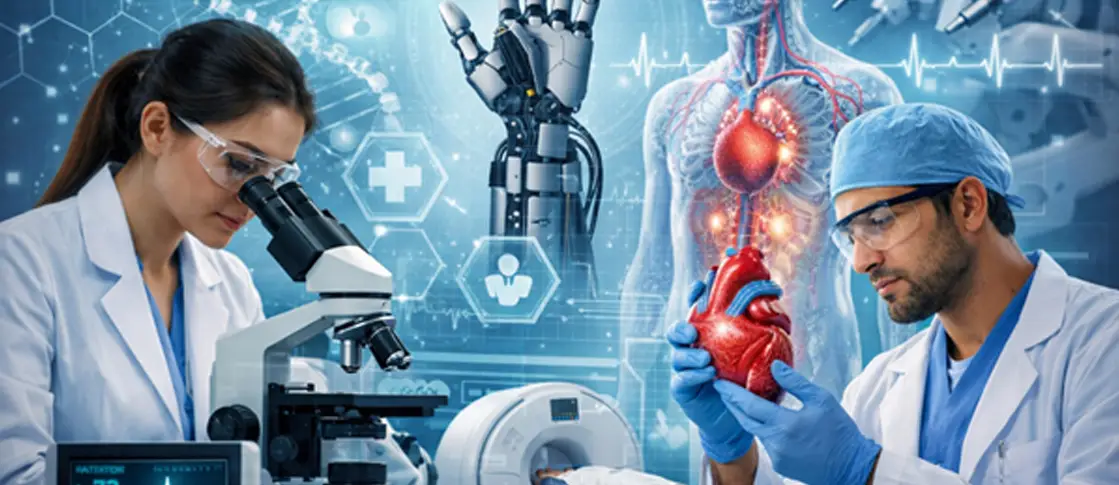
- Biomedical Engineer - Design, Develop, And Maintain Medical Equipment and Healthcare Devices.
- Clinical Engineer - Manage and Support Medical Technologies in Hospitals and Healthcare Facilities.
- Medical Device Design Engineer – Work On Development Of Innovative Diagnostic And Therapeutic Devices.
- Biomedical Researcher – Contribute To Research In Medical Technology, Bioinstrumentation, And Healthcare Solutions.
- Healthcare Technology Consultant – Provide Expertise In Selection, Usage, And Management Of Medical Equipment.
- Healthcare Technology Consultant – Pursue MTech/MS/PhD in Biomedical Engineering, Medical Imaging, Biomechanics, Or Related Fields.
Fee Structure
Yearly
| 1st Year | 2nd Year | 3rd Year | 4th Year |
|---|---|---|---|
| ₹2,50,000 | ₹2,00,000 | ₹2,00,000 | ₹2,00,000 |
Semester Wise
| 1st Sem | 2nd Sem | 3rd Sem | 4th Sem | 5th Sem | 6th Sem | 7th Sem | 8th Sem |
|---|---|---|---|---|---|---|---|
| ₹1,50,000 | ₹1,00,000 | ₹1,00,000 | ₹1,00,000 | ₹1,00,000 | ₹1,00,000 | ₹1,00,000 | ₹1,00,000 |
Admission Process
Complete the Application
Appear for Entrance test and interview
Get shortlisted and Received the offer letter
Eligibility
10+2 or equivalent examination with Physics and Mathematics as compulsory subjects along with one of the Chemistry / Computer Science (IT). At least 50% marks in the above three subjects taken together. The Candidate must have passed English as a subject in 10+2 Examination. Merit in University Entrance Exam (Q-CARE), IITJEE (Mains), State Level Entrance Exams shall be given preference. In addition, candidates will have to successfully complete Goenka Aptitude Test for Admission (GATA) and appear for a personal interview.


 About Us