Home › Sustainability › SDG 3: Good Health and Well-being
3Sustainable Development Goal

Good Health and Well-being

Ensure healthy lives and promote well-being for all at all ages.

At GD Goenka University, health is part of how we teach, how we run the campus and how we work with our neighbours. We train the physiotherapists, nurses, pharmacists, optometrists, psychologists and public health professionals that India's health system needs. We look after the physical and mental health of our own students and staff, and we take care and health education into the villages, schools and markets around Sohna, Gurugram and Nuh.

This page sets out our work under each Times Higher Education SDG 3 indicator, with links to the policies and evidence behind it.

Our approach

A health-promoting university

We follow the Okanagan Charter for Health Promoting Universities and Colleges, which asks universities to build health into every part of campus life and to lead health promotion in their communities. Our Health and Well-being Framework turns that idea into named services, owners and standards, and is reviewed by the University's Health and Well-being Committee, chaired by the Vice Chancellor.

Learning and research

Health professions programmes in the School of Healthcare and Allied Sciences and the School of Liberal Arts prepare graduates for clinical, community and public health roles. Faculty research on rehabilitation, mental health, nutrition, eye health and health technology feeds directly into teaching and patient care.

A healthy campus

Students and staff have free primary care, free and confidential counselling, sexual and reproductive health services, a fully smoke-free campus, sport and fitness facilities, and healthy food. Mental health is treated with the same seriousness as physical health.

Community health

Faculty and student volunteers run free health and physiotherapy camps, screening and awareness programmes in nearby villages, government schools and markets. We give particular attention to older adults, daily-wage and migrant workers, and people with disabilities.

Indicator 3.1

Research on health and well-being

3.1
pdf

Research at GDGU starts from health problems we see in our own clinics and camps. Research in the School of Healthcare and Allied Sciences covers musculoskeletal and neurological rehabilitation and exercise-based care. Psychology faculty in the School of Liberal Arts work on stress, emotional resilience and school mental health. Colleagues in nursing, nutrition, optometry, pharmacy and public health study diet and chronic disease, eye health, safe use of medicines and access to care in rural Haryana.

Our partnership with the Foundation for Innovation and Technology Transfer at AIIMS New Delhi supports the move of health technology ideas from the laboratory towards patients. Students take part through dissertations, the REACH international conference hosted by the School of Healthcare and Allied Sciences, and poster and paper presentations on World Physiotherapy Day.

Times Higher Education measures this indicator directly from Scopus publication data.

Evidence: GDGU Scopus institution profile and SDG 3 research themes
University leaders and Park Hospital representatives open the Physiotherapy OPD on the GD Goenka University campus
Opening of the Physiotherapy OPD, run by the School of Healthcare and Allied Sciences with Park Hospital. The clinic is also a teaching and research site.

Indicator 3.2

Proportion of graduates in health professions

3.2.1
pdf
3.2.2
pdf

A large share of GDGU's graduates qualify in a health profession. Our programmes combine classroom teaching with supervised clinical postings in partner hospitals, community camps and the University's own outpatient clinics, so students learn to assess and treat patients long before they graduate. Teaching follows the standards of the relevant regulators, including the Indian Nursing Council, the Pharmacy Council of India and the National Commission for Allied and Healthcare Professions.

  • Physiotherapy (BPT, MPT)
  • Nursing
  • Pharmacy (B.Pharm, M.Pharm)
  • Optometry
  • Public Health (MPH)
  • Clinical and Counselling Psychology
  • Medical Laboratory Sciences
  • Medical Radiology and Imaging Technology
  • Cardiovascular Technology
  • Clinical Embryology
  • Nutrition and Health
  • Ph.D. in health disciplines
Evidence: graduate list by programme, certified by the Controller of Examinations

Indicator 3.3.1

Current collaborations with health institutions

3.3.1
pdf
Yes. GDGU works with local, national and global health institutions to improve health and well-being outcomes. None of these partners is owned or managed by the University.

Each partnership is set up for a purpose: clinical training for our students, referral care for patients we see on campus and in camps, joint health camps, and research. Park Hospital runs an outpatient clinic on our campus, and the Neuroaid and Research Foundation works with our physiotherapists on camps for people with neurological conditions.

Local

  • Vardaan Hospital and Trauma Centre, Sohna
  • Akropolis Superspeciality Hospital, Badshahpur
  • Upkar Multispeciality Hospital, Sohna Road
  • Ergophy Advanced Physiotherapy and Chiropractic Clinic
  • Prohealth Imaging and Diagnosis
  • Ishwar Eye Centre

National

  • Park Hospital, Gurugram
  • Medanta Institute of Education and Research
  • Artemis Hospital
  • Marengo Asia Hospitals
  • QRG Medicare
  • FITT, AIIMS New Delhi
  • The Neuroaid and Research Foundation
  • Zeiss India
  • Times Path Labs

Global

  • Bukhara State Medical Institute, Uzbekistan
  • Bezmialem Vakıf University, Türkiye
  • Partner universities for health education and research

Indicator 3.3.2

Health outreach programmes in the local community

3.3.2
pdf
Yes. Students and staff deliver health outreach for local communities, disadvantaged people, and migrant and refugee communities.

Our outreach is led by faculty and carried out by student volunteers from the School of Healthcare and Allied Sciences, the NSS Unit, the Rotaract Club and Unnat Bharat Abhiyan. It covers the themes THE asks about: hygiene, nutrition, family and maternal health, sport and exercise, ageing well and mental health.

Free physiotherapy and health camps

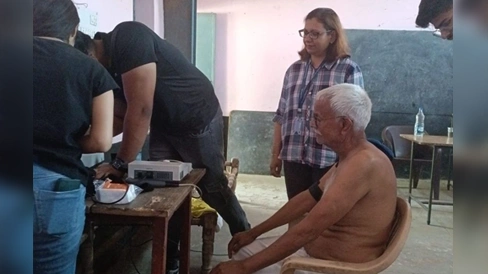
The Department of Physiotherapy takes its clinic to Indri, Alipur, Ghamroj, Mehendwara, Nuh, Faridabad and the Sohna grain market. At each camp, students screen patients for pain, joint stiffness, weakness and posture under supervision, teach a home exercise programme and refer those who need more care to the University's Physiotherapy OPD, where follow-up is free.

Who we reach

  • Local communities: village households, government school students and teachers, and families attending health awareness days.
  • Disadvantaged people: older adults, farm and daily-wage workers, people with disabilities, and para-athletes, who receive free physiotherapy support at matches.
  • Migrant workers and their families: camps at the Sohna grain market and in villages are open to everyone, whatever their origin, and reach porters, labourers and their families who rarely see a health worker.

Awareness on campus and beyond

Departments mark World Heart Day, World Diabetes Day, World Sight Day, Contact Lens Health Week, Pharmacovigilance Week and World Alzheimer's Day with screening stalls, talks and student campaigns open to the whole community.

A physiotherapist checks the blood pressure of a grain-market worker at a free camp in Sohna
Consultation for grain-market workers at Sohna Anaj Mandi.
A physiotherapy student examines an elderly patient's wrist at a community camp in Faridabad
A BPT student examines a patient at the Faridabad camp.

Indicator 3.3.3

Shared sports facilities

3.3.3
pdf
3.3.3 Sports
pdf
Yes. GDGU shares its sports facilities with local schools and the public.

Physical activity protects both physical and mental health, and many schools and villages near the campus have no safe place to play. The University's grounds, courts, swimming pool, gymnasium, shooting range and yoga centre are open to the community through the Sports Club.

  • Local government schools can use the facilities free of charge. Bookings: sports@gdgu.org.
  • Residents, clubs and schools take part free in University sports events such as ACCELERON and SPORTOPIA, and on Sports Day.
  • On other days, community groups can book facilities at a modest session rate.

Indicator 3.3.4

Sexual and reproductive health-care services for students

3.3.4
pdf
Yes. All students have free, confidential access to sexual and reproductive health information, education and care.

We treat sexual and reproductive health as part of ordinary health care, offered privately and without judgement.

  • Consultation: free clinics with the Park Hospital doctor on campus, a woman doctor or gynaecologist every month and on call, and referral to Park Hospital for tests or specialist care.
  • Counselling: free, confidential sessions with a clinical psychologist on relationships, consent, sexual health and emotional well-being.
  • Education: regular workshops on adolescent health, menstrual hygiene, contraception, sexually transmitted infections and reproductive rights, run by the Department of Psychology and health sciences faculty.
  • Menstrual hygiene: sanitary napkin dispensers and disposal units on campus.
  • Support for student parents: pregnant and parenting students can ask the Dean of Student Welfare for academic flexibility.

Indicator 3.3.5

Mental health support for students

3.3.5
pdf
Yes. Students have free, confidential mental health support, and the University promotes good mental health throughout the year.

Our student mental health policy follows the Supreme Court of India's 2025 guidelines on student well-being and the UGC guidelines on psychological and emotional health. It is published, reviewed every year and backed by trained people.

Promotion and prevention

Mental health literacy is part of induction. Each October the Department of Psychology holds a Mental Health Week with free psychological assessment stalls, street plays and expert talks. Stress-management and psychological first-aid workshops run every semester, and faculty mentors keep in regular touch with their students, especially around examinations.

Free counselling and crisis support

The Counselling Cell, staffed by qualified counsellors and a clinical psychologist, offers free one-to-one and group counselling. Students can walk in, write to mentalhealth@gdgu.org or be referred by a mentor, warden or friend. The Tele-MANAS helpline (14416) is displayed across hostels and classrooms, wardens and mentors are trained in a written crisis protocol, and students who need psychiatric care are referred to partner hospitals.

Students and faculty listen to a mental health and dementia awareness talk at GD Goenka University
Students and faculty at an awareness talk on World Alzheimer's Day.

Indicator 3.3.6

Smoke-free policy

3.3.6
pdf
Yes: smoke-free campus. Policy created 2019 · reviewed 2025 · no designated smoking areas. Read the Smoke-Free and Tobacco-Free Campus Guidelines →

GDGU is fully smoke-free and tobacco-free, in line with the Cigarettes and Other Tobacco Products Act, 2003, the Prohibition of Electronic Cigarettes Act, 2019 and the Government of India's Tobacco-Free Educational Institution guidelines.

  • Smoking, vaping and smokeless tobacco are banned in every building, hostel, ground, car park and University vehicle. There are no smoking areas or ashtrays anywhere on campus.
  • Tobacco products cannot be sold, advertised or sponsored on campus, and the University accepts no tobacco-industry funding.
  • Tobacco Monitors, signage at every entrance and regular reminders keep the rule visible.
  • Anyone who wants to quit gets free cessation counselling and is referred to the National Tobacco Quit Line (1800-11-2356).

Indicator 3.3.7

Mental health support for staff

3.3.7
pdf
Yes. All employees have free, confidential mental health support, and the University promotes staff well-being actively.

Every employee, from faculty to drivers and housekeeping staff, can see the clinical psychologist free of charge and in confidence. Counselling is also open to employees' immediate family members by appointment.

The Centre of Mental Health, led by the Dean of the School of Liberal Arts, runs workshops for staff on stress management, mindfulness, emotional resilience and work–life balance, including the "Happiness at Workplace" series. Staff who need specialist psychiatric care are referred to partner hospitals.

Mental and physical health go together. The School of Healthcare and Allied Sciences runs free physiotherapy health check-ups for faculty and staff, with an individual plan and a follow-up review, and the Department of Optometry runs "Vision for Every Role" eye screening for support staff, with subsidised spectacles for those who need them.

A health sciences student checks a staff member's blood pressure at the staff health camp
Staff physiotherapy health check-up camp.
Support staff register for free eye screening run by the Department of Optometry
"Vision for Every Role" eye screening for support staff.

On campus

Health services for students and staff

Most services are free. All of them are open to every student and employee.

Campus Health Centre

An infirmary in each block with a doctor and nurse on duty round the clock, free basic medicines and an ambulance on campus.

Health and Wellness Centre

The GD Goenka Memorial Healthcare and Wellness Centre at Gate 3, with doctor consultations and the Physiotherapy OPD.

Park Hospital OPD

Free monthly clinics and subsidised weekly clinics on campus, with referral to Park Hospital.

Physiotherapy OPD

Assessment and rehabilitation by faculty physiotherapists at subsidised rates, free for disadvantaged patients and para-athletes.

Counselling Cell

Free, confidential counselling for students, staff and staff families, with crisis support and referral.

Sport and fitness

Sports complex, swimming pool, Fit Fusion gym and yoga centres, free for students and staff.

Health in action

From our camps and clinics

Contact

SDG and Sustainability Cell
GD Goenka University, GD Goenka Education City, Sohna Road, Gurugram, Haryana 122103

Email: sustainability@gdgu.org

Medical emergency (24 hours) +91-7015991388 · medicaldeptt@gdgoenka.ac.in
Ambulance (24 hours) +91-9650790470
Campus Health Centre +91-7015991387 · +91-7015996742
Counselling Cell mentalhealth@gdgu.org
Tele-MANAS helpline 14416 or 1-800-891-4416
Sports bookings sports@gdgu.org
Admission Enquiry