
7 Aug 2024
Physiotherapy camp, Faridabad
Free health check-ups, posture assessments and injury-prevention guidance for residents of Sector 31, with the RWA.

End poverty in all its forms everywhere.
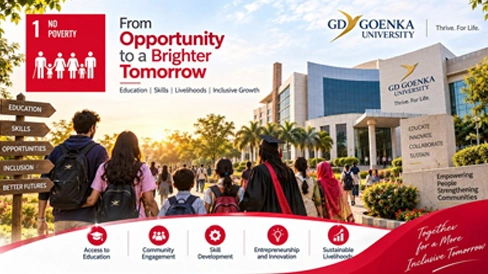
Poverty is more than low income. It can mean limited access to education, healthcare, nutrition, housing, work and other essential services. At GD Goenka University we respond with access to higher education, skills, enterprise and support for the communities around our campus.
This page sets out our work under each SDG 1 indicator for academic year 2024–25 (July 2024 to June 2025), with the programmes and evidence behind it.
Our approach
Lasting poverty reduction needs more than financial help. We combine scholarships with the support that keeps students in their studies, training that leads to work, and direct engagement with neighbouring villages.
Seats reserved for low-income, NGO-sponsored and international students, scholarships and fee waivers, and a Financial Aid Help Desk for government schemes.
Free support services on campus, mentoring and career support, the AVISHKAR Centre for start-ups, and industry-linked vocational training open to the wider community.
Health camps, clean-water and sanitation drives, literacy support in government schools, donation drives and policy dialogue with the Centres for Law and Governance.
Indicator 1.1
Faculty and researchers are encouraged to take up interdisciplinary research, publish their findings and develop evidence-based responses to poverty-related challenges. Publications, funded projects and community-based studies add to knowledge, inform our own initiatives and support sustainable socioeconomic development.

Indicator 1.2
Aid comes from the University’s own resources and from government and partner funds that the University directs to students. It is awarded on a merit-cum-means basis, and the Financial Aid Help Desk helps students apply for government scholarships.
Awards are decided by the Scholarship Award Committee, which reviews and recommends scholarships for each academic session.
Students enrolled
Low-income students receiving financial aid
Share of students receiving aid


First-year academic fee scholarship for Haryana-domicile UG and PG students with total family income up to ₹4,00,000 a year, under Section 36(2) of the Haryana Private Universities Act, 2006.
Underprivileged and meritorious girls and boys from Haryana, selected by Udayan Care and interviewed by the Scholarship Committee, receive 100% of their fees for their entire stay.
Fee freeships for 416 international students from 20 countries, worth ₹2,97,98,600 in 2024–25.
Financial Assistance to Girl Child, Student Learning Enhancement Support, Edu Empower schemes and Total Fee Waiver, benefiting 2,805 low-income students.
The Help Desk guides students through government scholarship applications, including the National Scholarship Portal. Schemes supported in 2024–25 include:
Indicator 1.3.1
GD Goenka University promotes equitable access to higher education for students from economically weaker sections, including those in the bottom 20% of household income groups in India and internationally. Financial constraints should not stop deserving students from pursuing quality higher education.
The University follows an inclusive approach to admissions. Through financial assistance, scholarships, merit-cum-means support and attention to applicants’ socioeconomic circumstances, it works to lower financial barriers and widen educational opportunity. This supports inclusive education, equal opportunity and social mobility, in line with SDG 4: Quality Education.
In line with Section 36(2) of the Haryana Private Universities Act, 2006, 25% of seats go to students domiciled in Haryana, and 10% belong to low-income families with an annual family income of up to ₹4,00,000. A further 5% of seats are earmarked for underprivileged students sponsored through NGOs, and 5% are reserved for female students. The University also keeps 10% of admissions for international students, and offers designated admission benefits to wards of defence personnel and outstanding sportspersons.
Bars are drawn on a scale where 25% fills the track.

Indicator 1.3.2
GD Goenka University supports the retention, academic progression and graduation of domestic students from economically disadvantaged backgrounds, including the bottom 20% of household income groups. It monitors academic performance, semester-wise progression, retention and graduation rates, and aims to strengthen retention and improve completion outcomes.
The 80% pass result shows successful progression among the cohort reported to us. It reflects that cohort only, and we keep working to support every student who needs help to finish.
pass result, reported low-income cohort, AY 2024–25
Minimum share of students the University aims to see pass at the first attempt.

Indicator 1.3.3
GD Goenka University supports vulnerable students to continue and complete higher education. These measures reduce financial and social barriers, support student well-being and development, and help economically disadvantaged students stay in their studies.
Need-based and merit-cum-means support to help students continue their studies.
Lower the cost of education and living for students.
Free legal assistance and awareness through the Legal Aid Clinic, School of Law, for eligible beneficiaries.
Free consultations, diagnostics and physiotherapy services for students and staff.
Free, confidential counselling, assessment, therapy and personality development.
Medical assistance, first aid and emergency support without additional charges, with links to nearby healthcare facilities.
Internet connectivity, Wi-Fi in the library and hostels, and library facilities that reduce technology-related barriers to learning.
On-campus fitness facilities open to students.
Sports, cultural and literary activities facilitated free of cost or without additional participation charges.


Indicator 1.3.4
The University facilitates access to scholarships, merit-cum-means assistance and information about applicable government financial-aid schemes to reduce financial barriers.
Academic support includes mentoring, bridge courses, remedial classes, academic guidance, personal counselling and career counselling to help students overcome academic and personal challenges. Together with the Corporate Resource Centre, these initiatives support retention, academic progression, timely completion and access to sustainable livelihoods, contributing to long-term socioeconomic empowerment and poverty reduction.


Indicator 1.3.5
GD Goenka University has a well-established International Office that provides 24/7 support to international students, including students from low-income groups and lower-middle-income countries. It helps with admission, transition and integration into the University’s academic and campus environment.
The University provides international fee freeships and fee waivers to eligible students, so that students from economically disadvantaged backgrounds can enter and continue higher education. During 2024–25, 416 students from 20 countries received financial support under these provisions, amounting to ₹2,97,98,600.
This widens access to education for economically vulnerable students, strengthens opportunities for social and economic mobility, and helps reduce the effect of poverty on access to higher education.

Indicator 1.4.1
GD Goenka University supports financially and socially sustainable entrepreneurship through the Avishkar Centre of Innovation & Entrepreneurship. The Centre offers mentorship, entrepreneurial guidance, skill development, industry interaction and access to institutional expertise and resources, with incubation support, innovation infrastructure and business-development guidance. The aim is to turn ideas into prototypes, products and viable businesses, and to move students from job seekers to job creators.
Through these initiatives the University encourages innovative business models, employment generation, sustainability and local economic development, contributing to inclusive growth and long-term community empowerment.
The Centre has supported ventures involving University stakeholders, including students and alumni.
Research and development in instrumentation, government manpower training and R&D projects.
Green technology and clean-tech solutions, recognised by DPIIT under the Startup India initiative.
Clothing e-commerce brand focused on trendy apparel and rapid delivery.


| Programme or activity | Type | Date |
|---|---|---|
| SIH Internal Hackathon 2024 | Competition | 6 Sep 2024 |
| Udyami Bazaar | Exhibition | 9 Oct 2024 |
| One day Management Development Program -Emotional Intelligence, Leadership, and Employee Well-Being. | Workshop | 10 Dec 2024 |
| International Colloquium on Future Proofing Human Rights in the Age of Artificial Intelligence | Colloquium | 10 Dec 2024 |
| Instructional design and continuous assessment practices | Workshop | 10 Dec 2025 |
| Intra Client Counselling competition | Competition | 9 Jan 2025 to 10 Jan 2025 |
| Intra Moot Court Competition | Competition | 16 Jan 2025 to 17 Jan 2025 |
| ICSSR Sponsored National Seminar on Enhancing Privacy Protection in the Digital Age: Legal Challenges and Innovations | Seminar | 24 Jan 2025 to 25 Jan 2025 |
| Capacity Building Workshop on Public Speaking for Networking and Entrepreneurial Skills | Workshop | 29 Jan 2025 |
| Field/Exposure Visit to FITT-IITD | Exposure Visit | 14 Feb 2025 |
| CiArb International Commercial Arbitration Moot Court Competition | Competition | 14 Feb 2025 to 16 Feb 2025 |
| Workshop on Design Thinking, Critical Thinking and Innovation Design | Workshop | 18 Feb 2025 |
| TEA: The Entrepreneurial Alumni | Mentoring Session | 19 Feb 2025 |
| Innovation Showcase: Demo Day/Exhibition/Poster Presentation of Innovations/Prototypes | Workshop | 22 Feb 2025 to 3 Mar 2025 |
| Felicitation of Idea Evaluation 2025 | Expert Talk | 22 Feb 2025 |
| National Science Day | Exhibition | 28 Feb 2025 |
| IDEA | Competition | 6 Mar 2025 |
| International Women's Day | Expert Talk | 7 Mar 2025 |
| WEAVE | Workshop | 7 Mar 2025 |
| Industrial Visit - Varun Beverages | Exposure Visit | 11 Mar 2025 |
| Session on "How to Plan for Start-up and Legal & Ethical Steps" | Seminar | 24 Mar 2025 |
| IndusLex Confluence | — | March 2025 |
| Ideathon | Seminar | 14 Apr 2025 to 15 Apr 2025 |
| Innovax | Business Plan Competition | 15 Apr 2025 |
| Inauguration of IP UTSAV and Celebration of World Creativity and Innovation Day | Seminar | 21 Apr 2025 |
| Mark the Spot: Trademarks Talk: Masterclass on Trademarks and Geographical Indications | Expert Talk | 24 Apr 2025 |
| Workshop on Intellectual Property Rights (IPR) and IP Management for Start-up | Workshop | 26 Apr 2025 |
| 7th ICON (International Conference) | International Conference | 27 Apr 2025 to 28 Apr 2025 |
| Summer Internship 2025 | Competition/Hackathon | 1 Jun 2025 to 31 Jul 2025 |
| Faculty Development Program - AIMA On Context to Concept: Crafting Impactful Case Studies | Workshop | 2 Jun 2025 to 6 Jun 2025 |
| World Environment Day | Mentoring Session | 5 Jun 2025 |
| FDP on Data Visualization | FDP | 22 Jul 2025 to 27 Jul 2025 |
The Skill Development Department offers practical, certified training that people from outside the University can join, often on our campus. Industry partners include Havells for electrician training, JSP (Jindal Panther) and JSW for fabricator and contractor training, and Crompton for engineer and electrician training.


The School of Agriculture Sciences and the Block Development Office, Sohna, organised a District-Level Kisan Mela for about 50 farmers and farm women from nearby villages. It promoted sustainable agriculture, millet cultivation and better farming practices through demonstrations and expert interactions.
The Mela also featured Verdanta, a local enterprise that empowers rural women through self-help groups and training in homemade pickle and candy production, supporting local start-ups, income generation and women’s economic empowerment.

The University employs people from nearby rural areas for gardening, security and maintenance. These jobs give neighbouring households a regular income and support the local economy.
Indicator 1.4.2
GD Goenka University contributes to the economic empowerment of the local community through employment, educational support and initiatives that encourage sustainable local entrepreneurship.
These opportunities promote self-employment, income generation, local enterprise development and inclusive economic growth. Related work, such as the Verdanta women’s self-help group featured at the Kisan Mela, is described under 1.4.1 Start-ups & skills.

Indicator 1.4.3
GD Goenka University runs community-based initiatives through the Goenka Social Impact Drive, NSS activities, Community Connect programmes, health camps, financial awareness camps, student-led outreach and donation drives in its 10 adopted villages.
These initiatives support underserved communities through literacy and educational activities, health check-ups, nutrition and hygiene awareness, sanitation and clean-water campaigns, water coolers installed in villages for safe drinking water, and the distribution of essential items. Students engage with local communities, understand their socioeconomic challenges and contribute to community development, in line with SDG 1.
The University installed water coolers in villages, including Ghamroj, so residents can get safe drinking water. The Gram Panchayat of Ghamroj wrote to thank the University for the RO-fitted water coolers, noting that clean, cool drinking water is now available to villagers, especially in the hot season.

Free check-ups, physiotherapy, eye-health sessions and mental-health programmes bring basic health services and information closer to residents.
7 Aug 2024
Free health check-ups, posture assessments and injury-prevention guidance for residents of Sector 31, with the RWA.

21 Aug 2024
About 33 patients received screening, pain management and rehabilitation advice at Shiv Mandir.

9 Sep 2024
Consultations and posture guidance with SOHAS and Park Hospital, Gurugram, run by the Health & Wellness Centre.

9 Oct 2024
Free 16PF and Emotional Intelligence assessments at Udyami Bazaar during Mental Health Week.

12 Nov 2024
A community workshop on yoga, mindfulness and stress management led by Dr. Juhi Srivastav.

15 Dec 2024
Physiotherapy students supported para-athletes at an event with the Neuro Aid Research Foundation.

19 Dec 2024
Students ran health assessments and physiotherapy consultations for participants.

15 Jan 2025
Basic health screening and guidance for 100 community participants.

13 Feb 2025
Awareness of eye care, screen exposure, nutrition and regular eye examinations.
On 15 February 2025 the Rotaract Club also held a webinar on heart health and nutrition for the wider community.

7 Apr 2025
58 nursing students and hospital attendees took part in a session on protein, balanced diets and affordable healthy eating.

16 May 2025
59 students in nine groups presented menus for different age groups during International Nurses Week.

18 Sep 2024
An NSS rally on sanitation, hygiene and safe water, with sanitary products distributed.

27 Sep 2024
A cleanliness and sanitation drive in Alipur with Navjyoti India Foundation, covering the village temple, chaupal and government school.

9 Aug 2024
School of Management students spoke with students and teachers about learning needs, especially for girls.

4 Sep 2024
NSS volunteers reached 23 children with a message about learning and opportunity.

25 Oct 2024
Literacy and numeracy activities, with stationery and learning materials provided.

7 Feb 2025
School of Education Sciences students engaged with teachers and children on learning needs.

7 Mar 2025
A scrapbook activity on cleanliness and waste management for Grades 6–8, with dustbins donated.
Students, alumni, NSS volunteers and other stakeholders collected and distributed clothing, hygiene items and other essentials to vulnerable communities.

20 Sep 2024
First-year BBA and B.Com students gave biscuits, fruit and fruit drinks to underprivileged children.
Indicator 1.4.4
The Centre for Corporate Law, Policy Research and Governance and the Centre for Constitutional Law and Human Rights bring together academics, policymakers, legal practitioners, industry representatives and subject experts. Roundtables and consultations support evidence-based recommendations on regulatory frameworks, social justice and human rights.
Through conferences, policy dialogues, roundtables and expert consultations involving government bodies, policymakers, academics, legal practitioners, industry, civil society and local communities, the University supports evidence-based discussion on inclusive governance, social justice, human rights and equitable development.
GD Goenka University also promotes skill development through government and non-government schemes, supports livelihood generation, and promotes entrepreneurship by hosting Udyami Bazar. These efforts feed into policy discussion and collaborative initiatives on poverty alleviation at local, regional, national and global levels.

Impact and way forward
By combining education, research and community service, we want people to have the skills and confidence to change their own socioeconomic circumstances.
Expand community-based training and micro-entrepreneurship programmes.
Strengthen collaboration with NGOs and social enterprises for larger outreach.
Enhance financial support mechanisms for students from disadvantaged backgrounds.
No Poverty in action


Policy framework and evidence
The University believes that economic hardship should never stop a capable student from entering, continuing or completing higher education, and that a university has a responsibility to support the community around it. The Policy sets out how GD Goenka University contributes to SDG 1, and rests on the view that ending poverty needs action on several fronts at once: building human capacity, promoting entrepreneurship, fostering economic self-reliance and promoting social equity.
It applies to students (UG, PG, Diploma and Ph.D.), faculty and staff, and to the rural and peri-urban communities around the campus. Students, faculty, staff, alumni, local communities, NGOs, industry and government agencies are involved in developing, carrying out and assessing it.
Seats for Haryana-domiciled and low-income students, NGO-sponsored students, female students and international students under Section 36(2) of the Haryana Private Universities Act, 2006.
See 1.3.1 →Merit-cum-means and Chancellor’s scholarships, aid for the girl child, learning-enhancement and Edu Empower schemes, research grants, support to faculty wards and a Financial Aid Help Desk.
See 1.2 →Monitoring of progression, retention and graduation, mentoring, remedial and bridge courses, and free legal, health, counselling and digital-learning support.
See 1.3.2 →The Corporate Resource Centre provides career mentoring, skill-gap identification, internships, certifications and placement-readiness training.
See 1.3.4 →International fee freeships and fee waivers, with records kept of students admitted and supported.
See 1.3.5 →Avishkar Centre training, mentoring and incubation, and local employment for people from surrounding communities.
See 1.4.1 →Work with NGOs, schools and healthcare institutions through health camps, donation drives and awareness programmes.
See 1.4.3 →Support for research on poverty, inequality, financial inclusion, inclusive education and livelihoods.
See 1.1 →Annual training in inclusive, non-stigmatising communication, confidentiality of students’ socioeconomic information, and referral to support services.
Seminars, workshops and participation in forums, with research findings and good practice shared with government bodies and partners.
See 1.4.4 →| Indicator | Evidence on this page | Source |
|---|---|---|
| 1.1 | One research paper and three book chapters, July 2024 to June 2025 | Annual Report 2024–25 |
| 1.2 | Student and aid figures (5,012 students; 2,805 receiving aid); Scholarship Award Committee recommendation sheets, September and December 2024; National Scholarship Portal applications | Annual Report 2024–25 |
| 1.3.1 | Seat provisions under Section 36(2) of the Haryana Private Universities Act, 2006 | No Poverty Policy; Annual Report |
| 1.3.2 | 80% pass result for the reported low-income cohort, AY 2024–25; 80% first-attempt pass target | Annual Report 2024–25 |
| 1.3.3 | Photographs of the Legal Aid Clinic, Health & Wellness Centre, psychological services, infirmary and sports facilities | Annual Report 2024–25 |
| 1.3.4 | Corporate Resource Centre sessions with Waters, ESolutions, Bajaj Capital, Syrma SGS, Johnson Controls and ICICI Bank | Annual Report 2024–25 |
| 1.3.5 | 416 students from 20 countries supported through international freeships, ₹2,97,98,600 | Annual Report 2024–25 |
| 1.4.1 | 32 listed activities, registered start-ups, Smart India Hackathon 2024 and innovation awards, Kisan Mela, and skilling programmes with industry partners | Annual Report 2024–25 |
| 1.4.2 | Campus employment for local residents, subsidised fees and transport for local families, and local enterprises around the campus | Indicator responses |
| 1.4.3 | Health, sanitation, nutrition and literacy events in adopted villages; thank-you letter from the Gram Panchayat of Ghamroj for the water coolers | Annual Report 2024–25 |
| 1.4.4 | Centre for Constitutional Law and Human Rights and Centre for Corporate Law, Policy Research and Governance; Constitution Day and Udyami Bazar | University website; Annual Report |
SDG and Sustainability Cell
GD Goenka University, GD Goenka Education City, Sohna Road, Gurugram, Haryana 122103
Email: sustainability@gdgu.org
| Admissions and enquiries | 99100 00062 · 98181 71304 |
| Website | www.gdgoenkauniversity.com |


 About Us
