
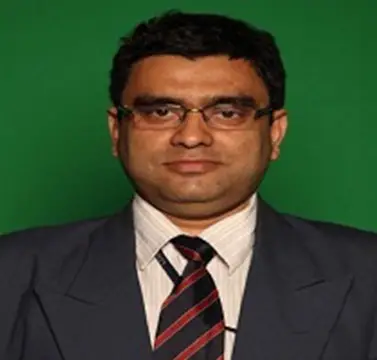
Dr. Debarka Mukhopadhyay
Professor

-

Qualification
Ph.D
-

College/University
Maulana Abul Kalam Azad University of Technology, Kolkata, West Bengal
Dr. Debarka Mukhopadhyay is an academician with over twenty years of experience, including more than a decade in academic administration, along with extensive teaching and research expertise. He is currently serving as a Professor in the Department of Computer Science and Engineering at GD Goenka University, Gurgaon.
He holds a Ph.D. in Computer Science & Engineering from Maulana Abul Kalam Azad University of Technology, West Bengal, and an M.Tech in Computer Science and Engineering from Kalyani Government Engineering College under West Bengal University of Technology.
Dr. Mukhopadhyay has made significant contributions to research and innovation, with 11 granted Indian patents and 9 additional patents published and under examination. His scholarly output includes 33 conference publications, 21 SCI/Scopus-indexed journal articles, 12 book chapters, and one edited book.
He has successfully supervised one Ph.D. scholar, while two scholars have submitted their synopsis, and four are currently pursuing doctoral research under his guidance.
His current research interests encompass Quantum Computing, Quantum Deep Learning, and Quantum-Inspired Drug Discovery, with a focused emphasis on designing molecular prototypes for greenhouse gas absorption to address climate change challenges.
An enthusiastic and result-oriented professional, Dr. Mukhopadhyay is committed to advancing cutting-edge research and fostering academic excellence.
Education:
Ph.D in Computer Science and Engineering from Maulana Abul Kalam Azad University of Technology, West Bengal, M.Tech in Computer Science and Engineering from Kalyani Government Engineering College under West Bengal University of Technology.
Research:
Quantum Computing, Quantum Deep Learning, and Quantum-Inspired Drug Discovery, with a focused emphasis on designing molecular prototypes for greenhouse gas absorption to address climate change challenges.
Publications:
Granted Patent:
- Sudipta Roy, Paramartha Dutta, Debarka Mukhopadhyay Siddhartha Bhattacharyya, “A Portable Molecular Quantum Dot Cellular Automata X-Ray System and Method of its Operation Thereof,” Patent Number with Grant date: 505621; 31/01/2024.
- Sudipta Roy, Paramartha Dutta, Debarka Mukhopadhyay, “Quantum Dot Cellular Automata Based Portable Industrial Radiography System,” Publication Number with date: 533167; 16/04/2024.
- Sudipta Roy, Paramartha Dutta, Debarka Mukhopadhyay, Ms. Sunanda Mondal, “Quantum Dot Cellular Automata Based Portable Cancer Cell Demolition System and Method of its Operation Thereof,” Patent Number with Grant date: 483853; 15/12/2023.
- Sudipta Roy, Paramartha Dutta, Debarka Mukhopadhyay, Kakali Datta, “Quantum Dot Cellular Automata Based Radiation Knife for Radiosurgery and Method of its Working,” Patent Number with Grant date: 477820; 06/12/2023.
- Paramartha Dutta, Debarka Mukhopadhyay, Siddhartha Bhattacharyya, “A Molecular QCA based UV lamp for Water purification,” Patent Number with Grant date: 406530; 13/09/2022.
- Tanmoy Chakraborti, Ayanava Das, Debarka Mukhopadhyay, “Apparatus and methodology for Quantum Cryptography inspired key generation and encryption for public communication,” Patent Number with Grant date: 473577; 28/11/2023.
- Debarka Mukhopadhyay, Suparba Tapna, ‘A Multi-Layer Memory Enriched Static Memory System’, Patent No and Grant Date: 424058; 04/03/2023.
- Tanmoy Chakraborti, Anirban Das, Debarka Mukhopadhyay, ‘An IoT System and method for shortest path estimation/planning for connected autonomous mobile bodies’, Patent Number with Grant date: 398526; 03/06/2022.
- Tanmoy Chakraborti, Anirban Saha, Debarka Mukhopadhyay, ‘A Ledger Platform for Secured Real-Time Transactions’, Patent Number with Grant date : 364876; 19/04/2021.
Major Publications in peer-reviewed scientific journals:
- S. K. Sinha and D. Mukhopadhyay, "Time Efficient Hash Key Generation For Blockchain Enabled IEEE Access, 12, 155867-155884, (2024).doi:10.1109/ACCESS.2024.3478845.
- Tapna, S., Chakrabarti, K., Mukhopadhyay, D. “A review on quantum utility for secure authentication protocol towards cryptographic standard in quantum dot cellular automata," Journal of Discrete Mathematical Sciences and Cryptography, 27(4), pp. 1415–1423, (2024). doi: 10.47974/JDMSC-1995.
- Padmaja, K., Mukhopadhyay, D. A Model for Detecting Type 2 Diabetes Using Mixed Single-Cell RNA Sequencing with Optimized Data,” SN Computer Science, 4(768), (2023). doi:10.1007/s42979-023-02215-z.
- Padmaja, K., Mukhopadhyay Debarka. “An Investigation of Complex Interactions Between Genetically Determined Protein Expression and the Metabolic Phenotype of Human Islet Cells Using Deep Learning," SN Computer. Science, 4(767), (2023). doi:10.1007/s42979 023-02222-0.
- Dharan, A.M., Mukhopadhyay, D. “A comprehensive survey on machine learning techniques to mobilize multi-camera network for smart surveillance,” Innovations in Systems and Software Engineering, 21(1), 313 - 332, (2023). doi:10.1007/s11334-023-00533-2.
- Debarka Mukhopadhyay, Tanmay Chakraborty, Anirban Saha, Koushik Mondal, and Roneeta Purkayastha, “Smart Mobile Device to Trace Moving Rogue Objects Utilizing Dynamic Source Dynamic Destination Tracking Algorithm," IETE Journal of Research, Taylor and Francis, 69(9), 5822–5829, (2022). doi:10.1080/03772063.2023.2173316
- Sunanda Mondal, Mili Ghosh, Kakali Datta, Debarka Mukhopadhyay and Paramartha Dutta, “A QCA design and energy analysis of binary semaphore with a comprehensive case study," Innovations in Systems and Software Engineering, Springer, 15(3-4), 343 - 354, (2019). doi:10.1007/s11334-019-00338-2.
- Mili Ghosh, Debarka Mukhopadhyay and Paramartha Datta, “Influence of structure of 2 Dimensional 2 Dot 1 Electron QCA cells in design of a pipelined subtractor," Microsystem Technologies, 28, 467–475, (2022). doi:10.1007/s00542-018-3826-1.
- Kakali Datta, Debarka Mukhopadhyay and Paramartha Datta, “Comprehensive design and analysis of gray code counter using 2- dimensional 2-dot 1 electron QCA," Microsystem Technologies, 28(2), 447 – 465, (2022). doi: 10.1007/s00542-018-3818-1.
- Mili Ghosh, Debarka Mukhopadhyay and Paramartha Datta, “Design of an Arithmetic Circuit using non-reversible adders in 2-dot 1 - electron QCA," Microsystem Technologies, Springer, 25(5), 719–1729, (2019). doi:10.1007/s00542-017-3526-2.
- Kakali Datta, Debarka Mukhopadhyay and Paramartha Datta, “Comprehensive Study on the Performance Comparison of Logically Reversible and Irreversible Parity Generator and Checker Designs using Two dimensional Two -dot One-electron QCA," Microsystem Technologies, Springer, 25, 1659–1667, (2019). doi:10.1007/s00542-017-3445-2.
- Kakali Datta, Debarka Mukhopadhyay and Paramartha Dutta, “Design and Analysis of an Energy E fficient and Compact Two-Dimensional Two-Dot One-Electron Quantum-Dot Cellular Automata Based Ripple Carry Adder,” International Journal of Convergence Computing, 2(2), 161-182, 2017. doi:10.1504/IJCONVC.2016.082034.
- Mili Ghosh, Debarka Mukhopadhyay and Paramartha Dutta, “A Study on 2 Dimensional 2 Dot 1 Electron Quantum Dot Cellular Automata based Reversible 2:1 MUX Design: An Energy Analytical Approach,” International Journal of Computers and Applications, Taylor & Francis, 38(2-3), 82-95, 2016. doi:10.1080/1206212X.2016.1218239.
- Debarka Mukhopadhyay, Paramartha Dutta, “A Study on Energy Optimized 4 Dot 2 Electron two dimensional Quantum Dot Cellular Automata Logical Reversible Flip Flops," Microelectronics Journal, Elsevier, 46(6), 519-530, (2015). doi:10.1016/j.mejo.2015.03.001.
- Debarka Mukhopadhyay, Paramartha Dutta. “Quantum Cellular Automata Based Novel Unit Reversible Multiplexer,” doi:10.1166/asl.2012.3266, Advanced Science Letters, 16(1), 163-168 (2012).
Major Publications in peer-reviewed conference proceedings:
- Aniket Sarkar, Sourav Mondal, Debarka Mukhopadhyay, Sourav De, Siddhartha Bhattacharyya, Jan Platos and Leo Mrsic (2024). Educational Management System Using Hybrid Blockchain Network. Proceedings of the 10th International Conference on Advanced Intelligent Systems and Informatics 2024. AISI 2024. Lecture Notes on Data Engineering and Communications Technologies, vol 220. Springer, Cham. doi:10.1007/978-3-031-71619-5_13
- Samanta, S., Sen, A.P., Mukhopadhyay, D., De, S., Bhattacharyya, S., Platos, J. (2024). A Brief Review on Different Machine Learning-Based Intrusion Detection Systems. In: Hassanien, A.E., Darwish, A., F. Tolba, M., Snasel, V. (eds) Proceedings of the 10th International Conference on Advanced Intelligent Systems and Informatics 2024. AISI 2024. Lecture Notes on Data Engineering and Communications Technologies, vol 220. Springer, Cham. doi:10.1007/978-3-031-71619-5_10.
- Padmaja. K and D. Mukhopadhyay, "An Human Islet Cell RNA-Seq for Genome-Wide Genotype Deepsec Framework Using Deep Learning Based Diabetes Prediction," 2023 International Conference on Network, Multimedia and Information Technology (NMITCON), Bengaluru, India, 2023, pp. 1-6, doi: 10.1109/NMITCON58196.2023.10276014.
- Padmaja. K and D. Mukhopadhyay, "An Predictive Deep Learning Model is used to Identify Human Tissue-Specific Regulatory Variations For Diabetes," 2023 IEEE 4th Annual Flagship India Council International Subsections Conference (INDISCON), Mysore, India, 2023, pp. 1-5, doi: 10.1109/INDISCON58499.2023.10270496.
- Tapna, S., Chakrabarti, K., Mukhopadhyay, D. (2022). “A Secure Communication Gateway with Parity Generator Implementation in QCA Platform,” In: Mukhopadhyay, S., Sarkar, S., Dutta, P., Mandal, J.K., Roy, S. (eds) Computational Intelligence in Communications and Business Analytics. CICBA 2022. Communications in Computer and Information Science, vol 1579. Springer, Cham. doi:10.1007/978-3-031-10766-5_15.
- Sinha, S.K., Mukhopadhyay, D., Bhattacharyya, S. (2023). “A Brief Review on the Role of Blockchain in Supply Chain Management,” In: Bhattacharyya, S., Banerjee, J.S., Köppen, M. (eds) Human-Centric Smart Computing. Smart Innovation, Systems and Technologies, vol 316. Springer, Singapore. doi:10.1007/978-981-19-5403-0_11.
- A. Nayak, S. De, S. Bhattacharyya, D. Mukhopadhyay, K. Muhammad and S. Gorbachev, "Envisaging an Intelligent Blockchain Network by Intelligence Sharing," 2022 International Conference for Advancement in Technology (ICONAT), Goa, India, 2022, pp. 1-6, doi: 10.1109/ICONAT53423.2022.9725973.
- Tapna, S., Chakrabarti, K., Mukhopadhyay, D. (2022). “A Novel Architecture of Flip-Flop for Processor-In-Near-Memory (PINM) using Ternary Quantum-Dot Cellular Automata (TQCA),” In: Das, A.K., Nayak, J., Naik, B., Dutta, S., Pelusi, D. (eds) Computational Intelligence in Pattern Recognition . Advances in Intelligent Systems and Computing, vol 1349. Springer, Singapore. doi:10.1007/978-981-16-2543-5_35
- Dutta, P., Mukhopadhyay, D. (2014). “New Architecture for Flip Flops Using Quantum-Dot Cellular Automata,” In: Satapathy, S., Avadhani, P., Udgata, S., Lakshminarayana, S. (eds) ICT and Critical Infrastructure: Proceedings of the 48th Annual Convention of Computer Society of India- Vol II. Advances in Intelligent Systems and Computing, vol 249. Springer, Cham. doi:10.1007/978-3-319-03095-1_77
- M. Ghosh, D. Mukhopadhyay and P. Dutta, "A novel parallel memory design using 2 Dot 1 electron QCA," 2015 IEEE 2nd International Conference on Recent Trends in Information Systems (ReTIS), Kolkata, India, 2015, pp. 485-490, doi: 10.1109/ReTIS.2015.7232928. K. Datta, D. Mukhopadhyay and P. Dutta, "Design of a 2-dot 1-electron QCA full adder using logically reversible half adders," 2015 International Symposium on Advanced Computing and Communication (ISACC), Silchar, India, 2015, pp. 278-284, doi: 10.1109/ISACC.2015.7377355.
- M. Ghosh, D. Mukhopadhyay and P. Dutta, "Design and analysis of two Dot one Electron QCA Ex-OR gate in logically reversible gate design," 2015 International Symposium on Advanced Computing and Communication (ISACC), Silchar, India, 2015, pp. 272-277, doi: 10.1109/ISACC.2015.7377354.
- Ghosh, M., Mukhopadhyay, D., Dutta, P. (2016). “2-Dimensional 2-Dot 1-Electron Quantum Cellular Automata-Based Dynamic Memory Design,” In: Das, S., Pal, T., Kar, S., Satapathy, S., Mandal, J. (eds) Proceedings of the 4th International Conference on Frontiers in Intelligent Computing: Theory and Applications (FICTA) 2015. Advances in Intelligent Systems and Computing, vol 404. Springer, New Delhi. doi:10.1007/978-81-322-2695-6_30.
- Datta, K., Mukhopadhyay, D., Dutta, P. (2016). “Design of a Logically Reversible Half Adder Using 2D 2-Dot 1-Electron QCA,” In: Das, S., Pal, T., Kar, S., Satapathy, S., Mandal, J. (eds) Proceedings of the 4th International Conference on Frontiers in Intelligent Computing: Theory and Applications (FICTA) 2015. Advances in Intelligent Systems and Computing, vol 404.Springer, New Delhi. doi:10.1007/978-81-322-2695-6_32.
- M. Ghosh, D. Mukhopadhyay and P. Dutta, "A 2D 2 Dot 1 electron Quantum Dot Cellular Automata based logically reversible 2:1 multiplexer," 2015 IEEE International Conference on Research in Computational Intelligence and Communication Networks (ICRCICN), Kolkata, India, 2015, pp. 300-305, doi: 10.1109/ICRCICN.2015.7434254.
- Kakali Datta, Debarka Mukhopadhyay, Paramartha Dutta (2017). “Design of a BCD Adder Using 2-Dimensional Two-Dot One-Electron Quantum-Dot Cellular Automata,” In: Mandal, J., Satapathy, S., Sanyal, M., Bhateja, V. (eds) Proceedings of the First International Conference on Intelligent Computing and Communication. Advances in Intelligent Systems and Computing, vol 458. Springer, Singapore. doi:10.1007/978-981-10-2035-3_35.
- Mondal, S., Ghosh, M., Datta, K., Mukhopadhyay, D., Dutta, P. (2018). “A Design and Application Case Study of Binary Semaphore Using 2 Dimensional 2 Dot 1 Electron Quantum Dot Cellular Automata,” In: Mandal, J., Sinha, D. (eds) Social Transformation – Digital Way. CSI 2018. Communications in Computer and Information Science, vol 836. Springer, Singapore.doi:10.1007/978-981-13-1343-1_36.
- Ghosh, M., Mukhopadhyay, D., Dutta, P. (2017). “A Study on Structural Benefits of Square Cells over Rectangular Cells in Case of 2Dot 1Electron QCA Cells,” In: Mandal, J., Dutta, P., Mukhopadhyay, S. (eds) Computational Intelligence, Communications, and Business Analytics. CICBA 2017. Communications in Computer and Information Science, vol 776. Springer, Singapore. doi:10.1007/978-981-10-6430-2_8.
Books/ Book Chapters:
12 (Book Chapters), 1 Edited Volume
Conferences:
As below
Featured in:
- Featured in academic and professional forums for contributions to Quantum Computing and advanced computational research.
- Invited speaker/panelist in national and international conferences, workshops, and seminars.
- Recognized for research contributions in quantum algorithms, quantum fidelity estimation, and emerging computing paradigms.
Teaching:
Courses/Programmes: Taught in B.Tech, M.Tech and PhD programs.
Teaching interests:
Quantum Computing, Deep Neural Networks, Algorithms etc
Practice:
Work Experience: 20 Years
MDPs/FDPs:
- Actively organized and conducted Faculty Development Programs (FDPs) in the areas of Quantum Computing, Artificial Intelligence, and Advanced Algorithms.
- Delivered expert lectures and hands-on sessions in sponsored FDPs under national initiatives such as AICTE/ATAL.
- Contributed to curriculum design and training modules for capacity building of faculty members and industry professionals.
Board Memberships:
- Member of Board of Studies (BoS) in Computer Science and Engineering for curriculum development and academic governance.
- Served on academic committees for program design, quality assurance, and accreditation processes.
- Contributed to institutional decision-making bodies related to research and innovation.
Service:
Editorial Positions:
- Serving/served as Editorial Board Member and Guest Editor for reputed national and international journals in Computer Science and Quantum Technologies.
- Involved in editorial activities including manuscript evaluation, special issue coordination, and peer-review supervision.
Reviewer Experience:
- Active reviewer for reputed journals and conferences indexed in Scopus and other leading indexing bodies.
- Reviewed research articles in areas such as Quantum Computing, Machine Learning, and Algorithm Design.
Professional Service:
- Contributed as session chair, technical program committee (TPC) member, and reviewer in international conferences.
- Mentored students and young researchers in emerging areas of Quantum Computing and interdisciplinary research.
- Actively involved in academic outreach, research collaborations, and institutional development initiatives.
Professional Memberships:
- IEEE
- ACM
- IETE
- ISTE
- B.Tech. in Civil Engineering ( B.Tech CE)
- B.Tech. in Computer Science and Engineering( B.Tech CSE)
- B.Tech. in Electronics and Communication Engineering ( B.Tech ECE)
- B.A. (Hons.) Psychology
- BA LL.B (Hons.)
- B.Sc. (Hons.) Agriculture
- M.Sc. Agriculture
- Ph.D SoAS Full Time
- Ph.D SoAS Part Time
- M.Tech in Aerospace Engineering
- B.Sc. (Hons. *) Forensic Science
- B.Sc. (Hons. *) Microbiology
- B.Sc. (Hons. *) Biotechnology
- B. Tech. in Electronics and Communication Engineering with Specialization in Biomedical Engineering in Association with BOSCH
- Bachelor of Computer Application – Cyber Security in association with CompTIA
- Bachelor of Computer Application – AI & ML –in association with Microsoft CloudThat
- M.Sc. - Forensic Science
- M.Sc. - Microbiology
- M.Sc. - Biotechnology
- Ph.D SoES Full Time
- Ph.D SoES Part Time
- BBA LL.B (Hons.)
- LLB (Hons.)
- LLM
- Ph.D Full Time
- Ph.D Part Time
- BBA (Hons.) in Hospitality Management
- Master of Business Administration (MBA)
- MBA in Agriculture Business Management *Offered by the School of Management
- BA (Hons.) in Culinary Arts
- MBA in Hospitality & Tourism *Offered by the School of Management
- Ph.D SoHT Full Time
- Ph.D SoHT Part Time
- Bachelor of Business Administration (BBA)
- Bachelor of Commerce (B.com)
- Ph.D SOM Full Time
- Ph.D SOM Part Time
- Bachelor of Pharmacy
- Master of Pharmacy in Pharmaceutics
- Master of Pharmacy in Pharmacology
- Masters of Pharmacy in Pharmacognosy
- Bachelor of Physiotherapy
- Master of Physiotherapy (Musculoskeletal Sciences / NeuroSciences)
- Master of Arts in Psychology
- Ph.D in Psychology Full Time
- Ph.D in Psychology Part Time
- B.Tech Fire and Safety Engineering
- M.Tech Health, Safety & Environmental Engineering (Full time)
- M.Tech Health, Safety & Environmental Engineering (Part-time)
- M.Tech Environmental Engineering
- M.Tech Environmental Engineering
- Ph.D CFE FT
- Ph.D CFE PT
- MBA - (ESG & Sustainability Management) *Offered by the School of Management
- Advance Diploma In Industrial Safety
- Certificate in ESG & Sustainability
- B.Sc. (Hons.) Clinical Psychology
- Professional Diploma in Clinical Psychology
- Master of Arts in Clinical Psychology**
- B.Sc. Nursing (Bachelor of Science in Nursing)
- Ph.D SoHAS Full Time
- Ph.D SoHAS Part Time
- Bachelor of Optometry (B.Optom)
- Master of Optometry (M.Optom)
- B.Tech. – CSE (Artificial Intelligence & Machine Learning) – with Curriculum Aligned to NVIDIA Deep Learning Institute (DLI)
- B.Tech in Artificial Intelligence and Data Science with Curriculum Aligned to NVIDIA Deep Learning Institute (DLI)
- B.Tech. – CSE (Cyber Security) – with Curriculum Aligned to CompTIA
- B.Tech Electronics and Communication Engineering
- B.Tech. – Mechanical Engineering (Specialization in Electric Vehicles) – iCAT
- B.Tech Aerospace Engineering
- B.Tech Aerospace Engineering with Pathway to Pilot Program
- M. Tech in Aerospace Engineering
- B.Des. (Hons.) Fashion Design & Technology
- B.Des. (Hons.) Communication Design
- B.Des. (Hons.) Interior Architecture & Design
- M.Design - Interior Architecture & Design
- Ph.D Design
- M.Sc. in Agriculture (Agronomy)
- M.Sc. in Agriculture (Genetics and Plant Breeding)
- M.Sc. in Horticulture (Vegetable Science)
- M.Sc. in Agriculture (Agricultural Extension Education)
- M.Sc. Floriculture & Landscaping
- B.Tech in Energy Engineering
- M.Tech in Renewable Energy Engineering
- Ph.D in Energy Engineering
- Ph.D in Aerospace Engineering
- B. Tech Electronics and Communication Engineering (with specialization in VLSI Design and Technology in Association with BOSCH)
- Diploma in Culinary Arts (Jan)
- Diploma in Pastry Arts (Jan)
- B.A. (Hons.) Liberal Arts
- M.Design - Communication Design
- M.Design – Product & Service Design
- B.Des. (Hons.) Animation & Film Making
- M.Design - Fashion Design & Technology
- B.Des. (Hons.) Product & Service Design
- B.Sc. Aviation in association with Redbird Aviation – CPL
- Bachelor of Computer Application - Data Science in Association with Microsoft CloudThat
- MCA (Master of Computer Applications)
- MCA (Master of Computer Applications) Data Science - NVIDIA
- MCA (Master of Computer Applications) Generative AI- NVIDIA
- Diploma in Culinary Arts ( Aug)
- Diploma in Pastry Arts ( Aug)
- M.A. (Political Science)
- B.Tech. - (Bachelor of Technology) - Energy Engineering
- M.Tech in Nuclear Engineering
- Master of Technology - Renewable Engineering
- B.Tech. in Electronics and Communication Engineering with Specialization in Quantum Technology
- B.Tech. in Computer Science and Engineering With Specialization in Quantum Computing
- Master of computer application (cyber security) - in collaboration with CompTIA
- Master of computer Applications (Blockchain Technologies)
- Post Graduate Diploma in Clinical Embryology*
- Bachelor of Medical Radiology and Imaging Technology (BMRIT)
- M.Tech in Computational Mechanics
- MBA in Aviation Management
- MBA in Energy Management
- Bachelors in Medical Laboratory Sciences (BMLS)
- B.Sc. Cardiovascular Technology (CVT)
- Integrated M.Sc. in Clinical Embryology
- M.Sc. in Clinical Embryology
- Master of Public Health (MPH)
- B Tech in Mechanical Engineering (specialization in Electric Vehicles)
- B.Tech. in Biotechnology
- B.Tech. Environmental Engineering


 About Us